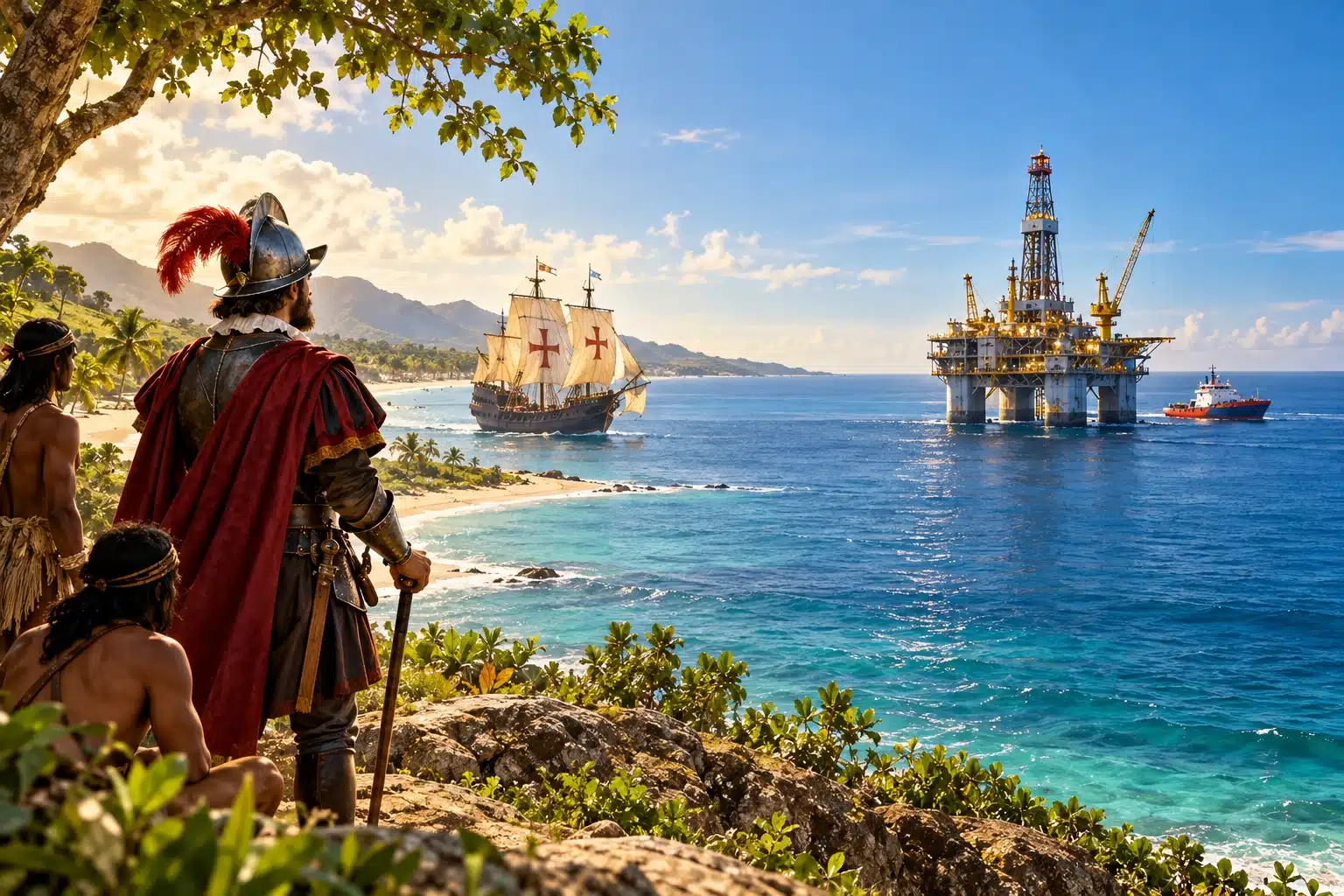
There is a dark, historic irony in the idea of a Dominican oil rush.
When Christopher Columbus dropped anchor off our northern coast in 1492, he didn’t just claim an island; he set off the original European fever dream. Long before Spanish conquistadors hacked their way through the South American interior chasing rumors of a gilded king named El Dorado, the obsessive search for gold actually started right here on Hispaniola. The Spaniards enslaved the native Taino, dredged the Yaque and Nisao rivers, and tore through the hills of Pueblo Viejo in a desperate scramble for precious metal.
When the easy surface gold ran out thirty years later, the Crown lost interest. The conquistadors packed up and moved on, leaving Santo Domingo behind to chase bigger myths in Mexico and Peru.
Five centuries later, Guyana found its own El Dorado—not in a lost city in the Amazon, but buried beneath eleven billion barrels of mud and offshore seabed. Almost overnight, a quiet rainforest nation turned into the fastest-growing economy on the planet, swept up in a dizzying whirlwind of per-capita GDP numbers and high-rise cranes.
Now, look back at our own southern coast. The San Pedro basin has long been a quiet phantom in local energy circles. Apache Corporation ran two thousand square kilometers of seismic scans across our seabed before packing up for Suriname and Guyana, leaving behind a mountain of raw data and an open question.
Our Ministry of Energy and Mines never archived those files. Exploration blocks remain quietly listed off San Pedro and in the deep sediments of Azua. What happens if a drill bit eventually hits light sweet crude thirty miles south of Palenque?
It means the conquistadors’ original dream comes full circle—only this time, the gold is liquid, black, and sitting under deep water.
Before anyone starts celebrating, we ought to take a hard look at what actually happens when a country catches the phantom it has been chasing since 1492.
First comes the sudden shock of foreign money. Long before a single barrel hits an export tanker, supply ships anchor off Haina and Caucedo. Real estate in Piantini and Naco spikes as energy firms drop corporate expense accounts on office space and high-end residential towers. Expat salaries push up neighborhood prices while local middle-class families watch their rent march completely out of reach.
Then the deeper structural damage sets in: classic Dutch Disease.
The Dominican Republic didn’t build the largest economy in the region by getting lucky on a single raw commodity. It built it on balance: zonas francas, agricultural exports, telecommunications, remittances, and a massive hospitality sector. A sudden oil boom threatens every single one of those pillars.
As crude exports pump billions of dollars into the central bank, the peso appreciates sharply. A stronger currency instantly makes a week in Punta Cana or Puerto Plata far more expensive than a trip to Jamaica or Mexico. It turns our organic cocoa, cigars, and medical devices into overpriced foreign goods overnight. Meanwhile, local logistics firms, construction sites, and hotels lose their best engineers and mechanics to offshore operators paying three times the local rate.
There is also a brutal physical reality that separates us from Guyana. Guyana’s offshore rigs sit off a sparsely populated rainforest coast with virtually no beach tourism at stake. Our seabed, by contrast, sits directly in the Caribbean Sea. A single deepwater platform leak off San Pedro drifting toward La Romana or Saona Island wouldn’t just be an ecological disaster—it would instantly paralyze an industry that feeds hundreds of thousands of Dominican families.
The ultimate gamble, however, is political.
When state coffers fill with automatic money straight from an offshore wellhead, governments stop relying on the productivity of their taxpayers. On paper, oil royalties could build modern transit networks, fix our broken electrical grid, and overhaul public schools. In practice, sudden windfalls create a feeding frenzy of patronage, inflated public contracts, and backroom licensing.
Finding El Dorado wasn’t a blessing for Hispaniola in 1492, and finding it offshore today wouldn’t be a simple jackpot either.
Striking oil off our southern coast would hand the country billions in cash and immense regional clout.
But a resource boom isn’t real wealth; it’s just raw leverage. If we ever use it to replace a diversified, self-made economy instead of reinforcing it, we will trade a resilient nation for a fragile, high-cost enclave living entirely at the mercy of global commodity prices.