
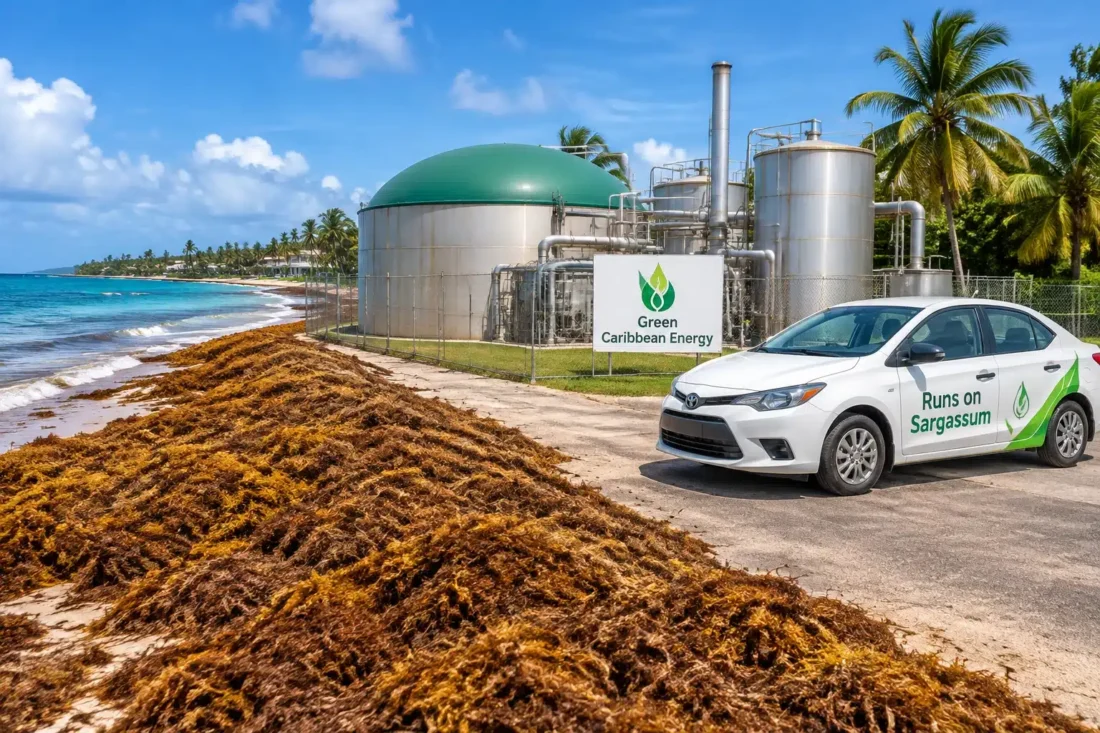
Every year, the Caribbean spends money removing sargassum from its beaches while importing fuel to keep its economies running. Researchers in Barbados have found a way to connect those two problems. But can the idea work across the region?
Let’s talk about two things the Caribbean has in abundance. One we pay dearly to import. The other we pay dearly to get rid of.
Energy and sargassum.
For decades, much of the Caribbean has depended on imported fossil fuels to keep the lights on, move people around, and keep businesses operating. When oil prices rise, shipping costs increase, or international supply chains run into trouble, the consequences quickly reach our shores.
Electricity becomes more expensive. Transportation costs rise. Food prices follow.
And there’s precious little we can do about it.
Meanwhile, another problem keeps washing up on our beaches.
Sargassum.
Those enormous brown mats of floating seaweed that have become an all-too-familiar sight along Caribbean coastlines. They interfere with fishing, threaten tourism, and leave coastal communities dealing with the unpleasant consequences of decomposing organic matter.
Local authorities spend considerable sums collecting it, transporting it, and finding somewhere to dispose of it.
Two expensive problems. Apparently unrelated.
Until somebody in Barbados decided to look at them differently.
Barbados Had a Better Idea
At the University of the West Indies’ Cave Hill campus, Dr. Legina Henry and her research team have been working on a rather interesting proposition.
What if the seaweed washing ashore could help produce the fuel the islands need?
Their approach combines sargassum with wastewater from rum production and manure from Barbados’ distinctive Blackbelly sheep.
Not exactly the ingredients you would expect to find at a modern filling station.
But there’s some straightforward biology behind it.
When organic material decomposes in an oxygen-free environment, microorganisms produce biogas, a mixture containing methane and carbon dioxide. The process is called anaerobic digestion, and it has been used commercially for decades.
The Barbados researchers adapted that principle to materials readily available on the island.
The resulting biogas can be purified to produce biomethane, a renewable fuel that can be used in appropriately equipped engines.
And here’s where the story gets interesting.

The Barbados project has demonstrated the use of sargassum-derived fuel in a vehicle.
Not a futuristic prototype that requires an entirely new transportation system. A vehicle operating on a combustible gas produced from organic waste.
That doesn’t mean every gasoline-powered car can simply switch to biomethane. Engines need suitable fuel systems, storage equipment, and safety measures.
Still, the significance is difficult to ignore.
Something that was costing money to remove has become a potential source of energy.
And the raw materials were already there.
Why Stop at Barbados?
Here’s where the rest of the Caribbean should start paying attention.
Barbados has no monopoly on sargassum. Nor does it have exclusive rights to rum distilleries, agricultural waste, or livestock manure.
Most Caribbean countries have some combination of these resources.
The question is whether they can turn them into something economically useful.
Consider Jamaica.
Its sugar and rum industries produce organic residues and wastewater. Livestock farming generates manure. Coastal communities face recurring sargassum arrivals.
The ingredients for a similar operation are certainly worth investigating.
But Jamaica wouldn’t necessarily need to copy the Barbados formula. Different waste materials require different processing conditions, and the economics depend on where those materials are collected and where the resulting energy is needed.
A properly located biogas plant might supply fuel for municipal vehicles, agricultural operations, or industrial heating.
Would it replace imported petroleum?
Of course not.
Could it reduce consumption in certain applications while helping solve a waste-management problem?
That’s a much more reasonable possibility.
And What About the Dominican Republic?
The Dominican Republic deserves particular attention.
We have a substantial agricultural sector, livestock production, rum distilleries, food-processing industries, and an extensive tourism economy.
We also have coastal areas where sargassum has become a recurring and expensive nuisance.
Places such as Punta Cana and Bávaro have experienced the problem firsthand. See: https://www.youtube.com/watch?v=_Yl9cMvKMio
Hotels and local authorities must deal with large quantities of seaweed, sometimes arriving faster than it can be removed.
And once collected, what happens to it?
Much of the discussion still revolves around disposal.
Perhaps we should be asking a different question.
Could some of that material be processed alongside agricultural residues, livestock manure, or suitable industrial wastewater to produce useful energy?
The Dominican Republic already has experience with biogas technology. The interesting opportunity would be to investigate whether sargassum could become an additional feedstock in appropriately designed facilities.
There may be applications for agricultural processing, industrial heating, or vehicle fleets.
But location matters.
Transporting wet seaweed over long distances could quickly consume the economic advantages of using it. A plant serving a coastal tourism area might make more sense than hauling the material halfway across the country.
And not every beach would be suitable for harvesting operations.
These are questions for engineers, environmental specialists, and investors to answer before anyone starts promising cheap fuel.
Still, the possibility deserves serious examination.
Even Trinidad Has Something to Learn
Trinidad and Tobago presents a different situation.
Unlike most Caribbean islands, it has an established natural gas industry.
So why would a country with natural gas reserves bother producing methane from seaweed?
Because energy policy isn’t simply about having fuel. It’s also about how efficiently resources are used.
Biogas production could provide a local waste-management solution, support smaller decentralized energy operations, and reduce emissions from certain organic waste streams.
That doesn’t automatically make it cheaper than conventional natural gas.
In Trinidad, particularly, the economic argument would have to be demonstrated rather than assumed.
But dismissing the idea simply because the country already produces gas would be equally shortsighted.
Now Comes the Less Glamorous Part
Before anyone announces that the Caribbean has discovered an unlimited supply of free energy, a few uncomfortable realities deserve attention.
First, sargassum is not a dependable year-round fuel supply.
Some seasons bring enormous arrivals. Others bring relatively little. A commercial digester needs a consistent supply of suitable organic material, which means finding reliable additional feedstocks.
Second, collecting seaweed isn’t free.
Boats, equipment, labor, transportation, storage, and processing all cost money. And harvesting must be managed carefully to avoid unnecessary damage to marine and coastal ecosystems.
Third, sargassum is not particularly clean material.
It contains salt and can accumulate arsenic and other potentially harmful substances. These can complicate digestion and create problems when disposing of the remaining material.
Biogas also requires treatment to remove contaminants, including hydrogen sulfide, before it can be used safely in engines.
And finally, there’s the matter of scale.
Producing enough biomethane to demonstrate that a car can run on it is one achievement.
Producing it reliably, safely, and competitively for hundreds of vehicles is quite another.
That distinction matters.
A successful demonstration is not yet proof of a commercially viable industry.
Barbados has shown that the concept deserves attention. The next challenge is demonstrating how far it can be taken.
We Have Seen This Movie Before
Every year, the same scenes play out across parts of the Caribbean.
Brown mats appear offshore.
Fishermen worry about getting their boats through them. Hotel operators watch the beaches. Municipal authorities scramble to organize cleanup operations.
Trucks arrive. Seaweed is collected. Money is spent.
Then everyone waits for the next wave.
Meanwhile, we continue importing enormous quantities of energy, exposed to prices and supply conditions largely beyond our control.
There’s a certain irony in that arrangement.
We spend money removing organic material that may contain recoverable energy, while spending more money importing energy from somewhere else.
Of course, not every ton of sargassum can be turned profitably into fuel. Some may be unsuitable for processing. Some may be too expensive to collect. And the environmental consequences of using it must be carefully assessed.
But surely it makes sense to find out how much of this recurring problem could become a useful resource.
Particularly when a neighboring island has already done some of the research.
The Caribbean Doesn’t Need to Reinvent Everything
One of the region’s persistent weaknesses is its tendency to approach shared problems as though each island were facing them alone.
Barbados develops a promising technology. Jamaica faces a similar environmental challenge. The Dominican Republic spends money dealing with the same seaweed. Smaller islands struggle with imported energy costs.
And too often, everyone works separately.
Why?
The Caribbean has universities, technical institutes, agricultural organizations, and regional bodies capable of sharing research and coordinating practical trials.
A project developed in Barbados could be studied in Jamaica, adapted to Dominican conditions, and evaluated in Saint Lucia or Antigua.
Not every experiment would succeed.
Not every location would justify the investment.
But that is precisely why cooperation matters. Sharing technical findings, including failures, could prevent countries from repeating expensive mistakes.
Rather than announcing ambitious national programs before the numbers are known, governments could begin with modest pilot projects.
Measure the available waste. Determine collection costs. Test different feedstocks. Calculate energy yields. Assess environmental risks.
Then publish the results.
If the economics work, expand.
If they don’t, find out why.
That’s how promising technology becomes a useful industry.
A Lesson Worth Learning
Barbados hasn’t solved the Caribbean’s energy problems.
It hasn’t discovered an inexhaustible fuel supply, and it hasn’t made imported oil obsolete.
What its researchers have done is demonstrate that a troublesome marine resource can contribute to producing a usable fuel.
That may sound less spectacular than announcing a renewable-energy revolution.
But it is considerably more useful.
The Caribbean doesn’t need another grand promise of energy independence. We’ve heard plenty of those.
What we need are practical ideas that can be tested, measured, improved, and, where they make economic sense, put to work.
Dr. Legina Henry and her colleagues have given the region one such idea.
And there’s no reason for every island to start from scratch.
We could learn from Barbados, adapt the technology to local conditions, and find out where it makes sense.
Because the real achievement wouldn’t be driving a single car on fuel made from seaweed.
It would be reaching the point where the next arrival of sargassum is no longer seen exclusively as another expensive problem, but also as a possible resource worth recovering.
And that would be quite a change for the Caribbean.