Based on Alec Corday’s documentary: What REALLY Happened at SANTO CERRO? | The MYSTERY of Santo Cerro
Every September 24th, thousands of pilgrims climb Santo Cerro in the Dominican Republic. They come to pray at the spot where Christopher Columbus planted a wooden cross in 1495—and where the Virgin Mary allegedly appeared on its beam to win a bloody battle against the Taíno.
It’s a great story. It’s also completely made up.
When you look at the oldest surviving 16th-century archives, there is no battle, no miracle, and no Virgin Mary. Instead, there is something far stranger: a forgotten letter to Emperor Charles V reporting a ghostly “…woman from Castile” sitting silently atop a cross on an empty hill.
Here is what the primary documents actually reveal about the Caribbean’s first “Woman in White.”
On September 24, I went up to Santo Cerro. The road was crowded from the bottom: stalls selling candles, rosaries, images of the Virgin, sweets, fried food and ice cream. At the top, the church was so full that people listened to Mass from the doors.
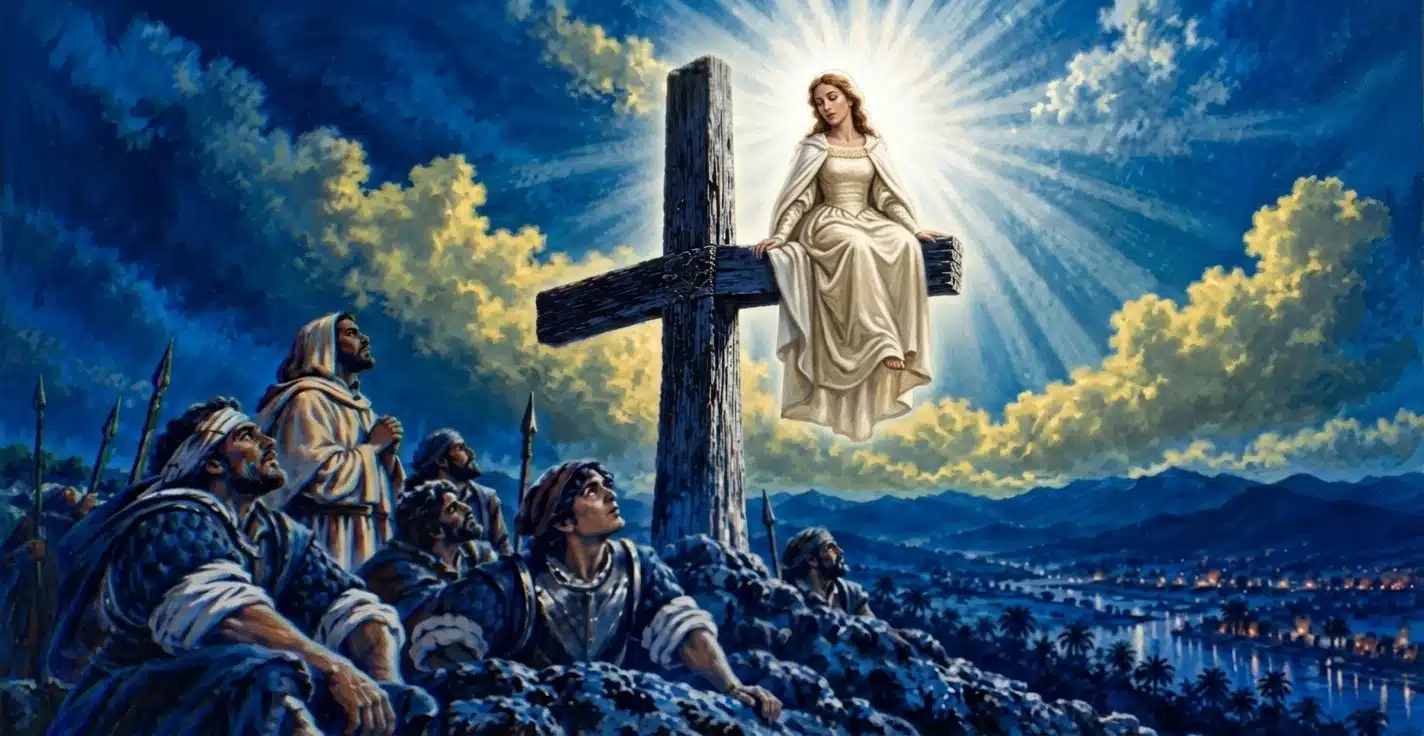
Everyone knows the story celebrated that day. In 1495, a small group of Spaniards was surrounded by thousands of Taíno people. A wooden cross refused to burn. And in the middle of the night, the Virgin of Mercy appeared above one of its arms.
It is a beautiful story. But when we turn to the oldest documents, a problem appears: the story we know today was not there at the beginning. It took shape, piece by piece, over more than three centuries.
A Battle Without a Miracle
The battle did take place. Hernando Columbus, the Admiral’s son, wrote that in March 1495 his father left La Isabela with about two hundred men, horses and twenty war dogs, and defeated an alliance of caciques in the Vega Real.
But his account contains no cross, no woman and no miracle. Nor does it describe the Spaniards as being on the verge of defeat: they were the ones who launched the attack. According to historical research cited in the Dominican press, the route described by Hernando suggests that the battle probably took place much farther northwest, near Esperanza and Mao. “La Vega Real” was not a town. It was the entire valley.
That distinction matters across the Caribbean. The Santo Cerro can preserve the memory of Columbus’s cross without being presented as the proven site of the 1495 battle.
The Cross Really Existed
What is documented is the cross. In 1520, Diego Columbus wrote in his will that the cross his father had ordered placed on the hill should be given a roof supported by four pillars, with a wooden railing, a door—and a lock. Twenty-five years after it was planted, it already needed protection: people were taking pieces of its wood as relics.
Columbus also had a special attachment to this land. One day before his death, he asked for a chapel to be built “there, where I invoked her, which is in the Vega, called Concepción.” According to his son Diego, he also wanted to be buried there. Neither wish was fulfilled.
His connection to the place therefore rests on more than later devotion. The 1506 testament of Christopher Columbus called for a family chapel and daily Masses in the town of Concepción de La Vega, while Diego’s 1520 codicil ordered the cross on the hill to be protected. The Santo Cerro is consequently part of the material history of Columbus and of one of the earliest Spanish foundations in the Caribbean—not merely the setting of a local legend.
“A Woman from Castile”
Around 1525, as La Vega grew poorer, local residents wrote to Emperor Charles V. They reported that Indigenous people had tried to knock down the cross without succeeding, and that “a very beautiful woman from Castile” had been seen above it.
A woman. They did not say she was the Virgin. And they did not mention any battle.
Even so, devotion grew. The emperor supported the site, pilgrims climbed the hill, and Santo Cerro became one of the earliest Christian pilgrimage sites in the Americas.
The hill also formed part of a larger colonial landscape. Concepción de La Vega, now known as La Vega Vieja, stood at the foot of Santo Cerro and was occupied roughly from 1495 to 1562. Archaeological work has identified the remains of a fortress, stone buildings, an aqueduct, wells, a foundry and the Franciscan monastery of San Francisco, built in 1502.
How the Woman Acquired a Name
In 1601, the king’s official chronicler, Antonio de Herrera, published a version containing new wonders: earth that returned to its place by itself and wood that regenerated. But there was still no Virgin and no battle involving Columbus.
Meanwhile, the Virgin of Mercy became the island’s patron after the earthquake of 1615, and Mercedarian friars eventually took charge of the hill. By 1681, an archbishop’s report referred to the “convent of Santo Cerro, of Our Lady of Mercy.” In 1695, a Jesuit letter finally said it: the woman was the Virgin Mary.
Even the date has an explanation. The battle took place in March. September 24, however, is the feast of Our Lady of Mercy throughout the Catholic world.
The Man Who Wrote the Legend—and Doubted It
The complete version—with the battle, Friar Juan Infante, the woman dressed in white at nine o’clock at night and the Virgin of Mercy—was written by historian Antonio Del Monte y Tejada in 1853. It was the version that entered schoolbooks.
What is curious is that Del Monte himself, immediately after describing the apparition, suggested that it might have been the product of the soldiers’ “exalted imagination.” The author of the official version was not entirely convinced.
What Remains Today
As the legend changed, so did the place. At first, the wood itself was said to heal. Later, it was the earth from the hole where the cross had stood, which people carried away in reliquaries. In the late nineteenth century, the American traveler Frederick Ober described a sacred well, a settlement that lived from pilgrims—and took to Chicago a bell, an iron cross and a cannon whose whereabouts no one seems to know today.
The Santo Hoyo, or Holy Hole, is still there. The medlar tree displayed beside the church is presented as a descendant of the original. And even within the Church, the story is being reconsidered: in 2025, the sanctuary circulated a lecture by historian José Guerrero concluding that the Virgin never appeared in a battle and that the true miracle of Santo Cerro was devotion to the cross.
The pilgrimage also remains part of the region’s present-day economy. On September 24, thousands of faithful are reported to visit the sanctuary, supporting vendors, transportation, food businesses and other local services. The Dominican government has promoted Santo Cerro as part of a broader La Vega destination combining religious, historical, ecological and gastronomic tourism. That development also raises practical questions about water, sanitation, roads and the capacity of the community to receive large crowds.
For the Caribbean, Santo Cerro belongs to a much wider geography of Columbian memory. Its cross and La Vega Vieja connect it to La Isabela, Santo Domingo, the debate over Columbus’s remains and the region’s continuing arguments over colonization, evangelization and heritage.
What Really Happened Here?
We will probably never know who—or what—that “woman from Castile” was. But we do know something: more than kings, chroniclers or friars, it was the believers who made this hill what it is. People climbed to pray before a cross, to ask for health and to give thanks.
Columbus was never declared a saint by the Catholic Church. There were later campaigns, in the nineteenth and early twentieth centuries, to promote his canonization, including efforts linked to Santo Domingo and the controversy over his remains. But the cause was never formally opened. The claim that he was supposed to become a saint belongs to the history of those campaigns—not to an official canonization.
Just as on September 24, before the Santo Hoyo, five hundred years later.
Written by Alec Corday. Prepared for review and approval by CaribDom.