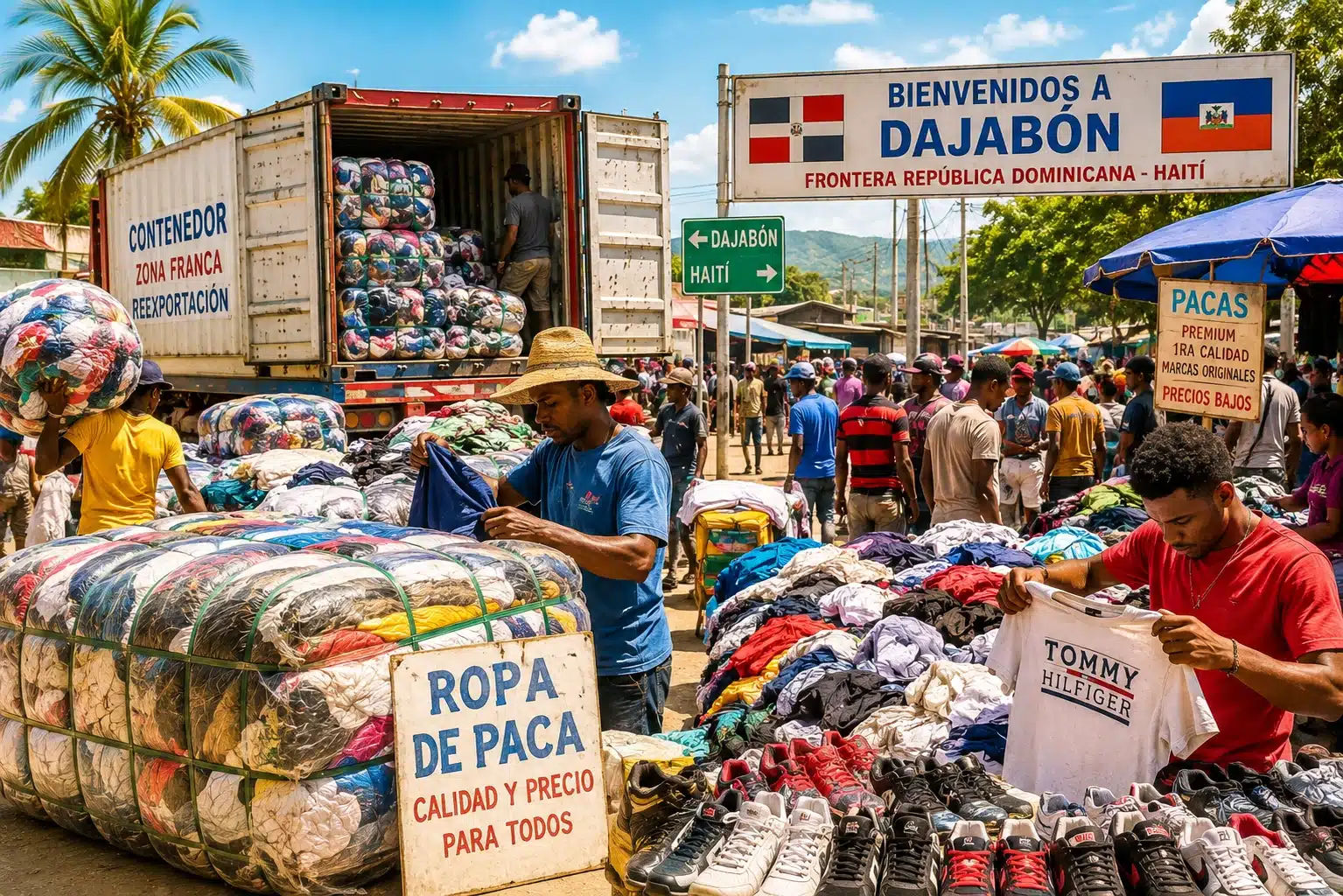
There are things in the Dominican Republic that we all know are there, but approach with the convenient caution of someone who prefers not to mention the Devil lest he be summoned. Baled clothing is one of them. It is on the corner of nearly every neighborhood, in the markets of the Cibao, in the deep south and, overwhelmingly, along the border. Everyone has bought a garment, thousands of families make a living selling it, and the business moves billions of pesos. Yet, if one looks at the cold letter of the law, the entire matter floats in a legal haze that shifts between prohibited, tolerated and openly clandestine.
The epicenter of this phenomenon has clear coordinates: the Dajabón binational market. One only needs to stand there on a Monday or Friday and watch the bridge over the Massacre River to understand the scale of the exchange. Thousands of people cross there, and, according to estimates by local authorities themselves, more than 400 million pesos move through the market each week. In that maelstrom, there are not only groceries, chicken or plastics. There are tons of compressed fabric. The dynamic also has its own irony: while Haitian shoppers come looking for food and medicine, Dominicans come looking for the clothing, shoes and appliances that Haitians bring from the other side to resell later in their respective towns. The border is not merely a geographic boundary or a source of political tension; above all, it is a commercial pressure cooker that exists and prospers precisely because it is a border.
Now, where does all that volume come from? Dominicans tend to assume that things simply “arrive,” but behind every bale is an impeccably oiled global mechanism. The story begins in United States closets with the famous spring cleaning, that springtime ritual in which the North American middle class empties its closets to throw out old items. But the real engine is not pure philanthropy; it is consumption. There is what academics call the “green disposal effect”: people donate used clothing to convince themselves that they are doing something good for the environment, which immediately gives them moral permission to go to the mall and buy new garments.
That flow of donations is channeled through organizations such as Goodwill and the Salvation Army. But contrary to the popular belief that the clothing is handed directly and free of charge to someone in need, the reality is commercial. Only 10 or 20 percent is sold in their local stores to fund their programs. The rest—the vast majority—is sold wholesale to textile recycling and export companies. Added to that is what is known as deadstock: corporate surpluses, returns and discontinued lines that large retailers would rather donate or liquidate for tax deductions than keep in inventory. All of it is sorted, pressed into 45-kilogram blocks and shipped in containers around the world. A bale that costs an exporter next to nothing becomes, upon arrival in Ghana, Kenya or the Dominican Republic, a marketable commodity. The initial charity mutates into a global business worth hundreds of millions of dollars.
On the island of Hispaniola, the phenomenon has deep roots. Used clothing began arriving in Haiti in large quantities in the 1960s under the name “Kennedy clothing,” linked to the humanitarian aid programs of the time intended to counter the influence of the Cuban Revolution. What began as free donations soon created its own local distribution and sales networks. By the 1980s, and with greater force after the 1986 crisis, Haitian women traders began crossing the Dajabón border to sell the merchandise on this side. Over time, the business on the Dominican side not only grew but took on a life of its own. Today, it does not depend solely on informal border crossings; large Dominican importers bring entire containers directly through the ports of Haina and Caucedo. According to Customs records, more than 42,000 tons of used clothing have formally entered the country in recent years.
And this is where the analysis collides with the island’s contradiction. Since 1973, the country has had Law 458, which explicitly prohibits the importation of used clothing and rags for health reasons, on the grounds that they can carry contagious diseases. The law bars anything coming from hospitals or anything of “undetermined origin.” But, as often happens with so many laws in our legislative history, reality ran right over the written rule.
Today, the sector operates in a highly convenient gray area. Customs allows shipments to enter if they are backed by disinfection certificates and pay taxes under certain tariff structures. At the same time, outright smuggling coexists with fraud by those who conceal new clothing inside the bales to evade the tariffs paid by formal commerce. A new dress that should pay hundreds of pesos in taxes ends up entering at a microscopic fraction of that cost if it is declared by the pound as used textile goods.
At this point, trying to eradicate or shut down the bale-clothing business in the Dominican Republic is a bureaucratic utopia. No government is going to pick that social fight. For ordinary citizens, the bale is the only democratic way to dress in quality brands at survival-level prices; for small merchants, it is their family’s livelihood; and for the state, it is a safety valve that prevents greater tensions in the informal economy. In the end, the bale will remain: walking the edge of legality, fueling cross-border commerce and showing that, on this island, market forces always find a way to wrestle the law to the ground.
Watch Alec Corday’s video: