Every spring, millions of North Americans participate in a comforting secular ritual. We clean out our closets, pack up bags of last year’s wardrobe, and drive to a local donation drop-off. As the heavy plastic bag slides into the bin, we feel a quiet hit of moral satisfaction. We freed up closet space, helped someone in need, and earned a clean slate to go buy something new.
It’s a neat, comfortable story. It is also almost entirely a fantasy.
What most donors don’t realize—or prefer not to ask—is that donation bins do not mark the end of a garment’s life. They are merely the intake valves for a multi-billion-dollar global commodity engine. Local thrift stores don’t give your clothes away for free, nor can they absorb the sheer tidal wave of fabric dumped on them every week. Only a fraction ever reaches a local sales floor. The vast majority, roughly 70 percent of usable donations, is sold off by the ton to commercial textile exporters.
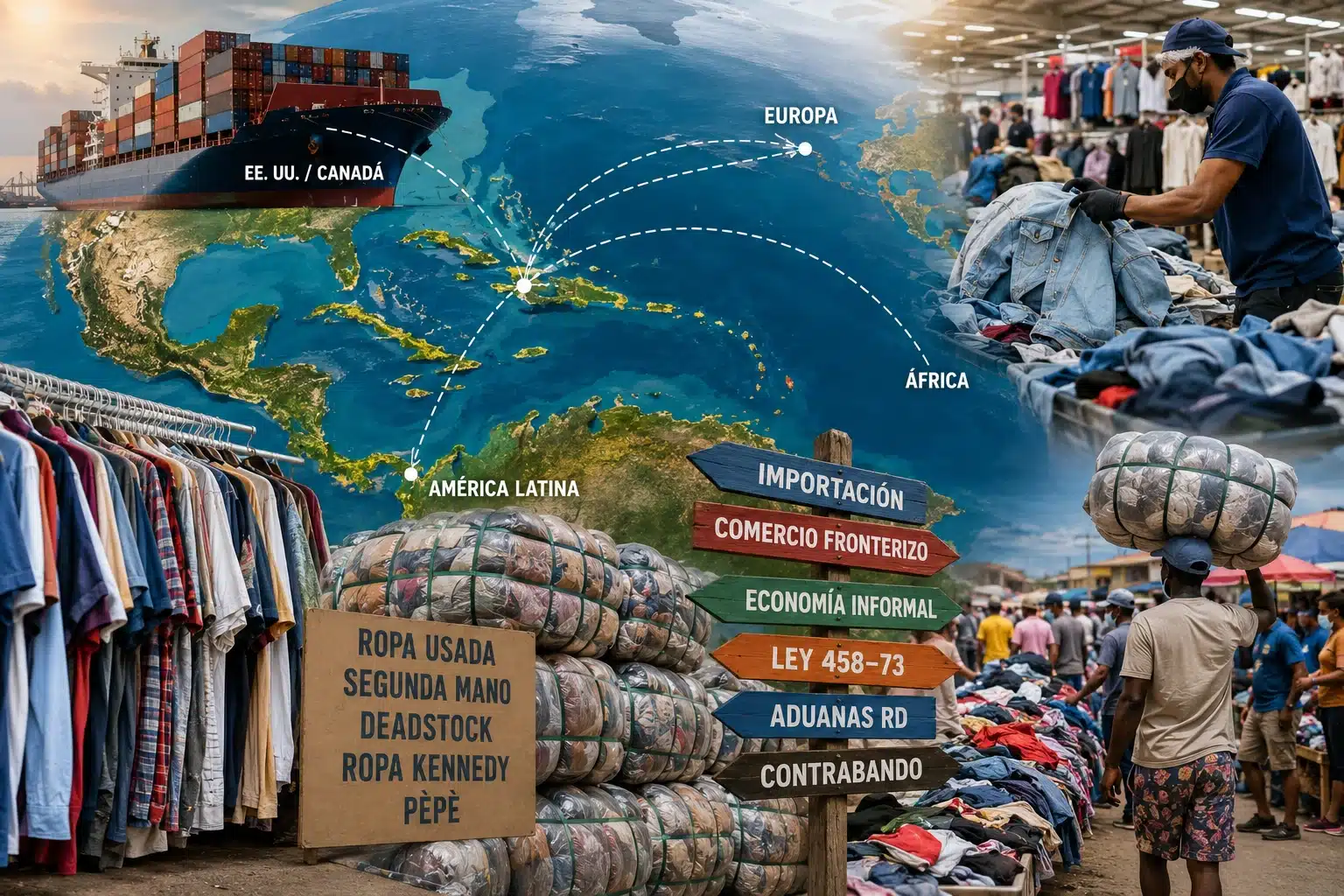
From there, your old jeans and faded t-shirts are graded, compressed into dense 100-pound plastic bales, and loaded into shipping containers bound for the Global South.
If you walk through the binational border market in Dajabón, between Haiti and the Dominican Republic, you will see those exact American bales—locally called pacas—being bought by the truckload. You’ll find them in the Mitumba markets of Kenya, the open-air stalls of Ghana, and resale centers across Latin America.
Yet, in places like the Dominican Republic, this massive trade exists in a state of deliberate legal schizophrenia. For over half a century, written law has explicitly banned the importation of used clothing on public health grounds. But as routinely happens with inconvenient legislation, daily economic reality simply ran right over the written word. Customs officials look the other way if a disinfection certificate is attached, while importers use the gray area to smuggle brand-new garments inside the used bales to dodge taxes. No administration dares to enforce the ban; doing so would spark a massive social conflict. The state treats it as an essential safety valve, proving once again that market forces always find a way to wrestle hypocrisy to the ground.
This isn’t inherently a tragedy; it’s an economy. These imported bales feed massive informal markets, creating hundreds of thousands of jobs for local merchants, border traders, and tailors. For lower-income families around the world, it is the only way to buy decent quality apparel at survival-level prices.
But let’s get real about why this system exists: it operates as a convenient psychological clearinghouse for the West.
Academics call it the “green disposal effect.” By convincing ourselves that our old clothes are going to a noble cause, we wipe away the guilt of overconsumption. The donation box acts as a hall pass, giving us moral permission to head straight back to the mall or tap “buy now” on the next fast-fashion feed.
Except there’s a catch that is catching up with everyone. As fast-fashion retailers flood the market with cheap, synthetic fabrics designed to fall apart after five washes, the quality of what lands in donation bins has plummeted. What used to be durable cotton is now low-grade polyester trash.
When those low-quality bales arrive overseas and can’t be sold, importing nations—few of which have the industrial waste infrastructure to handle American overproduction—are left holding the bag. The excess doesn’t end up on a grateful family; it ends up clogged in municipal drainage systems in Accra or piled high in burning desert dumps in Chile.
Donating functional clothing isn’t evil. Circulating used textiles is still infinitely better than tossing them straight into a domestic landfill. But it’s time to stop treating the donation box as a magic eraser for our shopping habits.
See Alec Corday’s video (Spanish)