October 1958. In a small private room in Tehran, Mohammad Reza Pahlavi, the Shah of Iran, dines surrounded only by family and close friends. There is a single stranger at the table: a Dominican diplomat. According to his own report, he was the only foreign representative invited that night.
It was an extraordinary moment. The Dominican Republic and Iran were separated by an ocean, spoke different languages and had no obvious reason to draw closer. And yet, between 1958 and 1961, the two countries built a relationship woven from sugar, oil, secret police and Cold War intrigue.
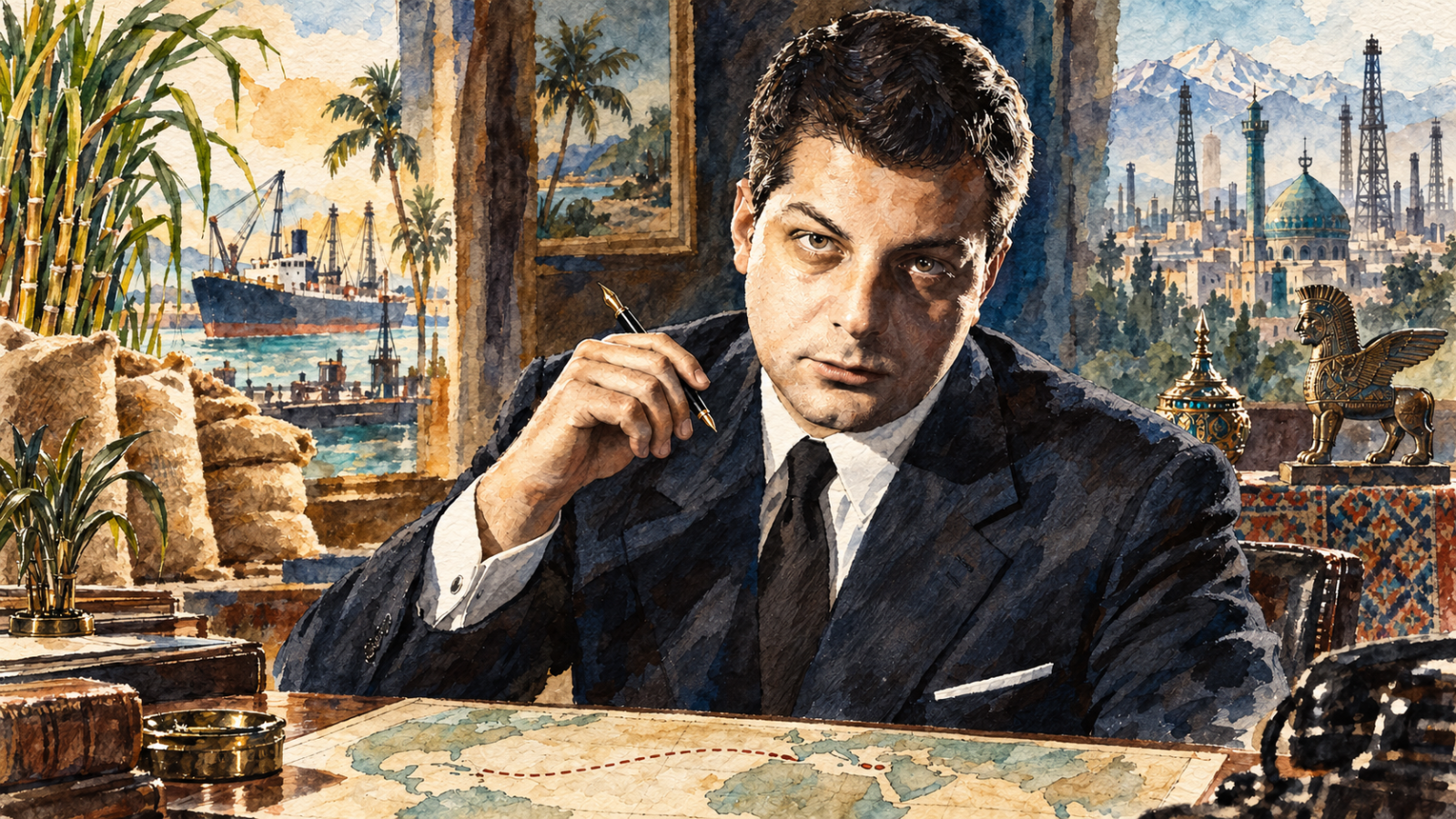
At the centre of it all was that diplomat: Leland Rosemberg, one of the most unusual figures in Dominican diplomatic history.
A DIPLOMAT WITH A KEY TO THE PALACE
Rosemberg was a Jewish businessman born in Switzerland who had become a Dominican citizen under Rafael Trujillo. He moved easily through European elite circles, counted Porfirio Rubirosa among his friends and was close to Ramfis, the dictator’s son.
But his most important connection to Iran came through another channel: his wife, Princess Minu Dowlatshahi. She had previously been married to Prince Hamid Reza Pahlavi, the Shah’s brother. Through that connection, Rosemberg had access—unusual for any diplomat—to the Iranian imperial court even before he formally became the Dominican representative in Tehran.
In July 1958, the Dominican government initiated the first formal contact with Tehran. Months later, Rosemberg arrived in Iran as chargé d’affaires. He initially operated from a hotel in the centre of the capital and, in November, opened the Dominican legation. It was a diplomacy built less on institutions than on personal relationships—and Rosemberg’s reached very high.
THE SWEET SIDE OF THE ALLIANCE
Sugar was the Dominican Republic’s main economic interest. Iran was one of the world’s largest importers of refined sugar, while political unrest in Cuba was disrupting the Caribbean sugar trade. Dominican sugar had already been reaching Iran since 1956, but the Trujillo government wanted a larger and more direct share of that market.
Rosemberg pressed Iranian officials and the Shah himself again and again. Iran, for its part, had reasons to diversify its sources away from Cuba after Fidel Castro’s victory. In 1960, Iranian officials discussed buying Dominican sugar for a new refinery, and the Shah ordered his senior officials to move the negotiations forward.
The plan soon became even more ambitious: Iran would exchange oil for Dominican sugar.
OIL, SANCTIONS AND A SECRET PLAN
By August 1960, the Trujillo regime was increasingly isolated. The Organization of American States condemned the Dominican regime at the Sixth Meeting of Ministers of Foreign Affairs, held in San José, Costa Rica, following the attempted assassination of Venezuelan President Rómulo Betancourt; a month later, the United Nations approved a new round of economic sanctions on oil and machinery imports. The Dominican Republic urgently needed alternative fuel sources and new trading partners.
Iran offered a possible way out.
The Shah authorized secret negotiations for an exchange of sugar for oil. Because Iran lacked sufficient refining capacity, one plan proposed sending Iranian crude first to a refinery in Italy before shipping it to the Dominican Republic. Another contemplated building a refinery on Dominican soil with international financing and technical assistance. Dominican delegates travelled to Tehran, while Rosemberg coordinated discussions involving Iranian, Italian and French interests.
Washington did not look favourably on this. The U.S. embassy in Tehran notified the Iranian government that funds received from the International Cooperation Administration could not be used to buy Cuban or Dominican sugar, and pressured Iran to buy from other partners using American ships—which would have sharply increased costs. Iranian authorities confirmed to Rosemberg that they would not allow themselves to be pressured by Washington and would seek other ways to honour the agreement.
When Venezuela later considered blocking oil shipments to the Dominican Republic, Iranian officials told Rosemberg that Tehran would provide the necessary crude and continue the barter negotiations. The refinery project was advancing on paper—but history moved faster.
AN INTELLIGENCE ALLIANCE
The relationship had a darker side. Both Trujillo and the Shah headed fiercely anti-communist regimes with powerful security apparatuses. Beginning in 1959, Dominican officials and SAVAK, Iran’s intelligence service, explored cooperation against those they considered “subversives”.
Documents cited in the chapter show SAVAK chief General Teymour Bakhtiar discussing lists of alleged communists with Rosemberg. Iranian agents were also instructed to monitor Venezuelan activity in the Middle East, while Tehran followed Che Guevara’s diplomatic travels with alarm. Venezuela mattered not only because of its opposition to Trujillo, but because it was emerging as an oil power and would soon help found OPEC alongside Iran.
The chapter’s author cautions that this cooperation probably produced few practical results. Even so, its mere existence is revealing: two distant regimes, each fearful of revolution and of being abandoned by the United States, briefly found value in sharing information about common enemies.
THE SOVIET TURN
As sanctions tightened, Trujillo did something few would have anticipated: he explored opening relations with the Soviet Union. Dominican and Soviet representatives held talks at the United Nations headquarters in New York, in Brussels, in Cairo and also in Tehran—confirming how central Rosemberg’s diplomatic position had become.
In April 1961, the Soviet ambassador to Iran, Nikolai Pegov, requested a formal meeting with Rosemberg to propose establishing diplomatic relations between Moscow and Santo Domingo, along with several Soviet cooperation programmes on the island. Moscow’s only condition was that the Dominican Republic improve its relations with Havana.
In other words, the same Trujillo who persecuted communists in his own country and worked with SAVAK to hunt them abroad was weighing—even as a last resort—an opening towards the USSR. Rosemberg, despite his openly anti-communist position, even acknowledged in his reports that the Soviet embassy in Tehran was more professional and better informed than the American one, which he criticised for its disinterest and its isolation from Iranian society.
A RELATIONSHIP THAT DIED WITH A DICTATOR
Trujillo’s assassination on 30 May 1961 abruptly ended the experiment. Rosemberg was in France with Ramfis Trujillo when the news arrived, and both immediately returned to Santo Domingo. Weeks later, he briefly returned to Tehran only to close the legation, taking his leave of the Shah in February 1962.
What Rosemberg said at that farewell reveals how profoundly the assassination had changed him. According to the French chargé d’affaires in Tehran, Rosemberg told the press that he was renouncing his Dominican nationality in opposition to the new regime, and openly accused the Kennedy administration of having promoted Trujillo’s assassination—an accusation with a basis: the chapter confirms that the killing was secretly organised by the CIA during the Kennedy administration, seeking political stability on the island and to avoid the risk of a second Cuba in the Caribbean. More surprising still, the Shah’s former loyal ally also began expressing sympathy for Fidel Castro because of his uncompromising hostility towards Washington.
The governments that followed Trujillo had little interest in preserving such a personal and politically sensitive relationship. Dominican ties with the United States and Latin America began to normalise, restoring the traditional routes for buying oil and selling sugar. The intelligence connection was an uncomfortable legacy, and neither side made a serious effort to revive the alliance.
For a few extraordinary years, however, the Caribbean and the Persian Gulf were connected by much more than geography would have suggested. Dominican sugar, Iranian oil, royal family ties, shared intelligence fears—and, in the end, even a flirtation with Moscow—wove an unusual alliance, so dependent on Rosemberg and Trujillo that it could not survive them.
It is a small chapter in Dominican history, but a fascinating one: proof that during the Cold War, even the most unexpected relationships could flourish quickly when trade, personal ambition and political survival pointed in the same direction.
Source note: This article is based primarily on the chapter by Fernando Camacho Padilla, “Iran and the Dominican Republic, 1958–1961: Trade and Intelligence Cooperation during Leland Rosemberg’s Mission to Tehran”, published in Iran and Global Decolonisation: Politics and Resistance After Empire (Gingko, 2023).