Why is Caribbean sand so white? The surprising truth: much of it is fish poop.
Have you ever wondered why the sand on Caribbean beaches such as Bahía de las Águilas, in the Dominican Republic, is so incredibly white and soft? The answer is surprising: much of that sand comes from parrotfish faeces.
Sand and geological origins
Sand is simply fine particles of eroded rock; its colour depends on the type of bedrock. For example, the Baní Dunes are dark because of iron-rich volcanic material, while on mountainous beaches such as Los Patos you will find local sediments and mineral fragments, sometimes even larimar. But in Bahía de las Águilas, the sand is extraordinarily white for another reason: the reefs and their inhabitants.
The parrotfish: the coral “dermatologist”
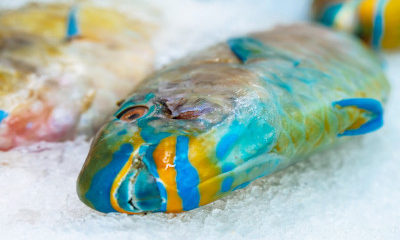
Parrotfish, from the Scaridae family, are colourful and recognisable by their beak-like mouths. There are at least a dozen species in the Caribbean. They are born female, and many species are protogynous—they can change sex when the group’s dynamics require it—with that change accompanied by variations in colour.
Their ecological role is crucial: with their strong beaks, they scrape and grind fragments of coral covered in algae, keeping reefs clean and preventing algae from suffocating the coral. This “maintenance” allows the coral to continue growing and to support reef biodiversity.
How coral becomes sand
When a parrotfish bites and crushes coral, a second set of teeth—pharyngeal teeth—grinds the material into fine grains. The fish extracts the nutrients and expels the rest as faeces: small grains of white, soft calcium carbonate. These grains accumulate on the seabed, and currents carry them to the beaches, forming the brilliant white sand we see.
It is estimated that in tropical areas, up to 85% of white sand comes from this activity. A parrotfish can produce between 100 and 300 kg of sand a year; large individuals can produce as much as one tonne annually and live for up to 20 years. This makes a single fish a “manufacturer” of tonnes of sand over its lifetime.
Ecological importance and threats
Parrotfish are essential to reef health and, by extension, to beaches and tourism. Without them, algae would grow unchecked, corals would weaken, and we would lose biodiversity as well as the white beaches that attract visitors.
However, these fish face clear threats:
- Overfishing, because their meat is valued in some local cuisines.
- Climate change, which causes coral bleaching and habitat loss.
- Pollution and the direct destruction of reefs.
In response, the Dominican Ministry of Environment has imposed a ban on catching parrotfish. Protection is urgent: without healthy parrotfish populations, the consequences would be ecological and economic.
What you can do as a visitor or resident
- Do not eat parrotfish or support their trade.
- Do not leave rubbish on the beaches; take your waste with you.
- Choose tours and operators with responsible snorkelling and diving practices that protect reefs.
- Support local conservation and environmental education projects.
A call to responsibility
The next time you walk across the white sand of Bahía de las Águilas, remember that you are standing on the product of the constant work of thousands of fish. They are small natural engineers whose survival supports an entire ecosystem and an entire tourism industry. Protecting them means protecting the landscape and the economy that depends on it.