
The Dominican Republic
Finance
The Creole Financial Miracle: Why Does the Dominican System Defy Economics Textbooks?
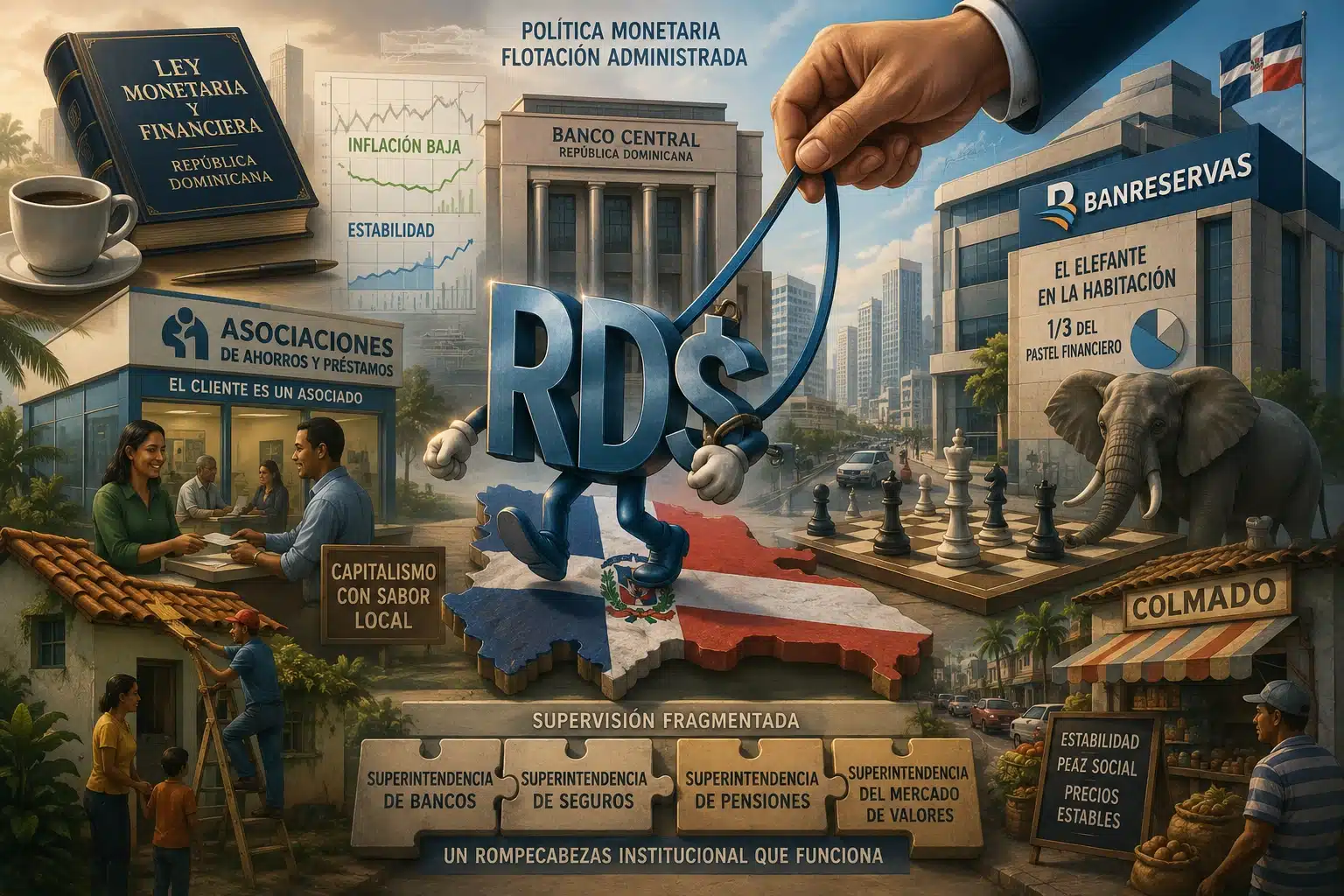
The Dominican financial system is, to put it mildly, a peculiar creature. If you sit down to read the Monetary and Financial Law with a coffee in hand, everything seems taken from a Basel manual: clear rules, a Monetary Board at the top deciding the fate of every peso, and a Central Bank operating with the precision of a Swiss watchmaker to keep the dollar from surging. But the reality of the streets—the reality experienced on the avenues of Santo Domingo or in the fields of the Cibao—moves to a different rhythm. Our system does not resemble those of our neighbors, and that is where things become interesting.
The first thing that jumps out at any analyst who examines the island closely is the mystery of the Savings and Loan Associations. In almost every other part of the world, money moves according to the appetite of shareholders hungry for dividends. Not here. Here, we created a mutualist model in which the customer is an “associate.” Although on paper it sounds like an idyllic cooperative from the last century, these institutions compete head-to-head with financial giants, financing most Dominican homes and managing fortunes with a spirit of trust that no digital banking algorithm has managed to replicate. It is capitalism with a local flavor that challenges traditional economic theory.
Then there is the elephant in the room: Banco de Reservas. While other Latin American countries dismantled their public banking systems during the waves of privatization in the 1990s, or confined them to dull development niches, the Dominican state held on to a heavyweight that fights at the center of the commercial ring. Banreservas is not a spectator; it handles one-third of the financial pie. This duality naturally generates skepticism. Is it healthy for the regulator and the principal player to share the same table at the National Palace? Supporters say it provides stability in times of crisis; critics say it distorts competition. The truth is that, so far, the boat is staying afloat—and with considerable success.
Where the hand of Dominican ingenuity is most evident is in the management of the dollar. While neighboring economies have surrendered completely to dollarization or allow the free market to destroy their currencies in times of turbulence, here the Central Bank plays the role of a skilled driver at an intersection without traffic lights. Its managed-floating policy is an open secret: officials intervene in the market, inject foreign currency when the outlook heats up, and withdraw it when things cool down. At the end of the day, the Dominican peso does not float; it is guided by the hand. It is pure, hard pragmatism that places social peace and the stability of the corner store above any ideological purity of the free market.
Let us look at the full picture. We have a highly fragmented supervisory system, with one superintendent for each sector instead of a single integrated megaregulator, as international fashion dictates. And yet, it works. It has weathered global storms and past local bank failures thanks to an almost surgical capacity for adaptation, opening the field to savings and credit banks in an attempt to bring into the fold the informal giant that moves the country. The Dominican financial system is neither perfect nor textbook-standard, but it is an exact reflection of our idiosyncrasy: a structure that defies the strict rules of theory but, in practice, knows how to remain standing.
At the end of the day, the Dominican financial system is like our own culture: a mechanism that appears chaotic on paper but moves with its own effective rhythm. The great question lingering in the air along Winston Churchill Avenue is not whether this model is good or bad, but how much longer the balancing act can continue. Are we witnessing a genuine miracle of Dominican resilience that the region’s economies should copy, or have we simply built a bubble of artificial stability sustained by the Central Bank’s constant intervention and the disproportionate weight of a state-owned bank?
If traditional economic theory says this should not work in the long term, someone is wrong: either the Washington manuals or our faith in the system. It remains to be seen whether Dominican ingenuity will continue rewriting the rules or whether, sooner or later, economic gravity will prevail.