You start looking into the history of the Dominican flag and end up tangled in a family affair where nobody asked permission to be born, but everyone shares a surname. Flags do not travel through the world alone. Put the maps of the Americas on the table and what you see is not graphic design, but a family tree shaped by inheritance, convenient copying, laundry-room accidents and the occasional uncomfortable cousin.
Maritime traffic and a Dutch accident
Before becoming solemn about anthems and school pledges, it is worth remembering that flags were born out of practical necessity. In the smoke of a land battle or the fog of the ocean, you needed to know whom to fire a cannon at—and whom not to fire at. During the age of sailing ships, enormous pieces of fabric were raised, larger than a public bus, simply to be noticed on the horizon. Spain’s red-and-yellow flag, in fact, was not born from a poetic epic but from a maritime-traffic problem in 1785: Spanish ships were white, like half of Europe, and out at sea nobody knew who was who until they were already exchanging gunfire.
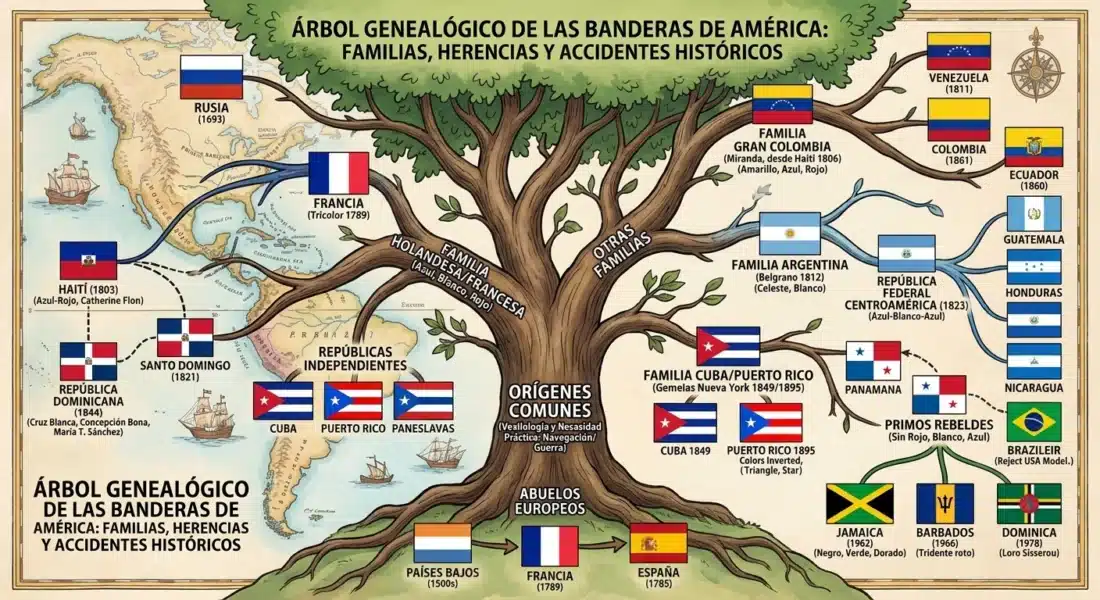
And if much of the continent now repeats the same refrain of red, white and blue, the cause was not some enlightened philosopher but textile chemistry and an accident in the Netherlands. In the sixteenth century, the Dutch fleet sailed under orange, white and blue stripes. The problem was that orange dye did not stand up to tropical sunlight or salt spray; over the months it faded until it became reddish. By the middle of the seventeenth century, the Dutch gave up and made red official. Because that commercial republic sent its ships across much of the planet, those three colors became fixed in the collective imagination as shorthand for independence and self-government. Tsar Peter the Great copied them for the Russian navy—although he was interested in shipyards, not democracy—and in 1789 the French Revolution adopted the tricolor. There was the direct grandfather of half the continent.
The 1800 template and unlikely twins
When the American colonies decided to break with Europe around 1800, there were no corporate-identity manuals. There was a template tested by blood and gunpowder: a few strongly contrasting colors, symmetrical shapes that looked the same from either side when the wind was blowing, and an emblem placed near the hoist—the only part visible when the fabric hung limp. Vexillology experts put it bluntly: when creating a flag, you either make yourself different or you show your family resemblance. Latin America generally chose to show the resemblance, even when history played tricks.
Take Haiti and Liechtenstein. The two countries’ flags were discovered to resemble one another around the 1936 Olympic era, and Liechtenstein added a crown in 1937 to distinguish its flag. The safer version of the anecdote is less cinematic than the usual story about identical twins marching side by side in Berlin, but it is still a useful reminder: sometimes national identity is settled by adding one small symbol to a familiar piece of cloth.
The Caribbean laboratory: from a mutilated flag to Duarte’s cross
In the Caribbean, this political laboratory became even more interesting. On May 18, 1803, during the war against France, Jean-Jacques Dessalines removed the white band from the French tricolor—the color associated with colonial rule—and Catherine Flon joined the remaining blue and red sections. Haiti’s independence followed on January 1, 1804, and the new republic adopted a blue-over-red bicolor, with later versions adding the national arms. It was the older sibling of our republics, although its flag, like its political history, went through several transformations.
On the eastern side of the island, our own history spun like a top before settling into place. In December 1821, José Núñez de Cáceres proclaimed the Ephemeral Independence and raised the flag of Gran Colombia, seeking to draw closer to Bolívar’s project. It lasted barely a moment. Weeks later, the entire island came under the government of Port-au-Prince and, for twenty-two years, what flew in Santo Domingo was a blue-and-red bicolor.
When Juan Pablo Duarte and the Trinitarians swore to establish a separate republic, they did not go looking for exotic colors. They took the blue and red already present on the island and crossed them with a white cross. Duarte made the meaning clear: it was not a symbol of suffering, but of redemption. It was an elegant way of saying that we recognized where we came from, but that from February 27, 1844, we were something else.
According to the Dominican government’s account, María Trinidad Sánchez, María de Jesús Pina, Isabel Sosa and Concepción Bona sewed the first flag, which was raised at the Puerta del Conde. Eight months later, the Constitution established the alternating quarters and placed a Bible, a cross and the motto “Dios, Patria, Libertad” at the center. No other national emblem has quite that combination of political declaration and religious text. We are not the only flag with a cross, but we are the only ones with this particular story.
The flag’s importance is not merely historical. Its use is governed today by constitutional provisions and Law 210-19 on national symbols. Official guidance says it must be displayed correctly, may not touch the ground and cannot be used for political, commercial or promotional propaganda. A recent practical guide issued by the Constitutional Tribunal and the Instituto Duartiano shows that, in the Dominican Republic, reverence for the flag remains an active civic and legal matter—not just a schoolroom memory.
Sisters in New York and the blue that reached the Super Bowl
Meanwhile, the family kept growing in New York’s exile communities. In 1849, Narciso López and Miguel Teurbe Tolón designed Cuba’s flag by combining American-style stripes with a Masonic triangle and Texas’s lone star. The flag was first raised in Cuba by López at Cárdenas in 1850 and was formally adopted by the Assembly of Guáimaro in 1869.
Nineteen years later, Ramón Emeterio Betances was conspiring from Dominican soil and created the flag of the Grito de Lares by crossing our Trinitarian banner with the Cuban star, dreaming of an Antillean Confederation. Finally, in 1895, Puerto Rican independence activists adopted the Cuban flag with its colors reversed. They are not cousins; they are twins who combed their hair in opposite directions.
Puerto Rico’s official law defines the flag as five alternating red and white stripes, a blue triangle and a white star, but does not specify a particular shade of blue. The difference between darker and lighter blues has nevertheless acquired political and cultural meaning, which is why a light-blue version can say something different from the official version without requiring a speech. In these islands, even the shade of a dye can become a political declaration.
Continental inheritances and rebellious nephews
Inland, the dynasties followed their own course. Francisco de Miranda first raised Venezuela’s yellow, blue and red flag at the Haitian port of Jacmel in 1806, leaving an inheritance later shared by Colombia and Ecuador after the breakup of Gran Colombia. Farther south, Manuel Belgrano improvised a sky-blue-and-white banner for his troops in 1812, which the privateer Hipólito Bouchard eventually carried by frigate to Central America. From there came the flags of Guatemala, Honduras, El Salvador and Nicaragua, with Honduras still carrying five stars at the center like the nostalgic relative who keeps photographs of the entire feuding family in a wallet.
Panama, faithful to its role as a hinge, rejected in 1903 a copy of the United States flag that the Frenchman Philippe Bunau-Varilla tried to impose and arranged four quarters to seal the peace between red liberals and blue conservatives.
And, as in every large family, the rebellious nephews arrived in the 1960s and refused to dress like the elders. At independence from the British Empire, Jamaica chose black, green and gold, becoming the only country in the world whose flag contains none of the familiar red, white or blue. Barbados split Britannia’s colonial trident in two to make clear that the empire was over. Dominica placed a Sisserou parrot at the center of its flag, surrounded by ten stars and set against a triple-colored cross, abandoning European political abstractions to say simply: this is my land and this is my wildlife.
These designs are not exceptions to the family story; they are arguments within it. Jamaica’s colors evoke the people, the land and the sun. Barbados’s broken trident symbolizes the break with colonial rule. Dominica’s flag brings together African heritage, Indigenous peoples, agriculture, forests and social justice. The Caribbean did not merely inherit a European color palette. It also turned landscape, ancestry and fauna into constitutional language.
What the fabric says when nobody is looking
In the end, the way each country treats its piece of fabric reveals its entire biography. In the United States, the flag is pledged to in schools, hung on porches and even printed on underwear. In Germany, where I come from, the scars of the twentieth century drained national symbols of any sacred fervor; nobody beats their chest over a piece of fabric. Here in the Dominican Republic, by contrast, the flag retains a reverential respect, with strict protocols and morning songs.
The regional family also has symbols beyond the national ones. CARICOM’s shared flag and passport belong to a longer history of Caribbean integration, from the West Indies Federation and CARIFTA to the Caribbean Community. They suggest that Caribbean identity is not only a collection of separate national stories. It can also be a project of mobility, cooperation and regional belonging.
When you look at the map of the Americas, then, you are not seeing a lack of imagination. You are seeing centuries of turbulent history speaking the same language with different accents. A dysfunctional family, without doubt—but a family all the same.
Based on the video by Kiskeya Life’s Alec Corday. Watch the video