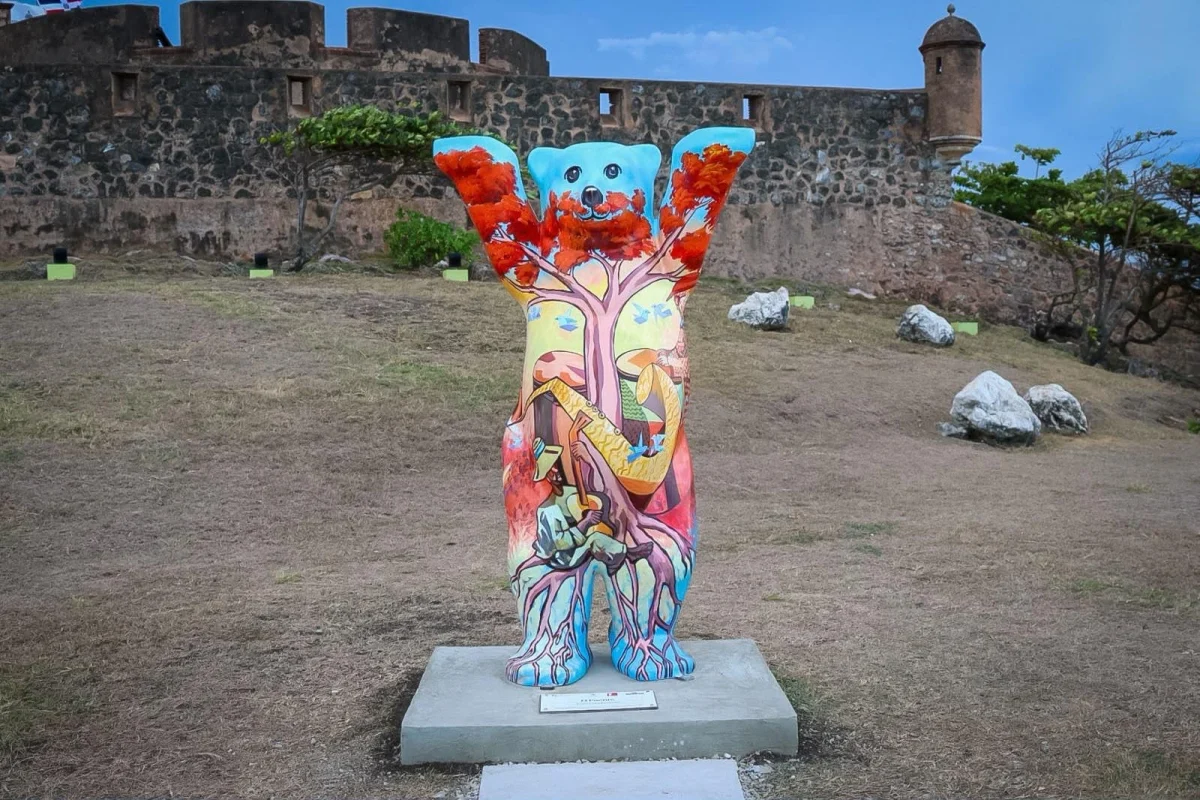

Flamboyán is not just a beautiful tree: it is one of the great protagonists of the Caribbean landscape—a symbol of freedom, Puerto Rican culture, Dominican identity, colonisation and art. It is a foreign tree that became so deeply rooted here that today almost nobody remembers that it was not born in this part of the world. Its story stretches from the jungles of Madagascar to the Caribbean, from the British Empire to the avenues of La Vega, from San Juan to the Valley of the Flamboyanes in Peñuelas, and from botanical science to your living room, where many of us have a painting of a flamboyán hanging on the wall.
The Hidden Origin of the Flamboyán
Flamboyán, also known as Delonix regia or Royal Poinciana, is not native to the Caribbean—or even to the Americas. Its origin is Madagascar, in the Indian Ocean, where the young Czech botanist Wenceslas Bojer discovered it at the beginning of the 19th century. Botanist William Jackson Hooker named it Delonix regia in 1837, and it soon became popular as “flamboyán” because of its fire-coloured appearance, from the French flamme (“flame”). Its rapid growth, broad shade and easily transported seeds made it a “green accomplice” of colonialism, first carried to British colonies, then to Asia and, finally, to the Caribbean.
From the Indian Ocean to the Caribbean
From Mauritius, a strategic point of the British Empire, the flamboyán spread around the world as a perfect shade tree for roads, squares and gardens. It reached India, where it is known as Gulmohar or Krishna Chura, and Bangladesh, where it is associated with the month of Boishakh. By the end of the 19th century, it was already in the Caribbean, from Florida to Venezuela, thanks to botanists and the imperial trade network. David Fairchild, Thomas Edison and Henry Ford in Florida, together with the tree’s arrival in the Dominican Republic and Puerto Rico, sealed its fate as a tropical icon, even though technically it was an outsider.
Symbol of Freedom and Culture
In the Caribbean, the flamboyán took on political and cultural meanings. Legend says that José Martí, Máximo Gómez and Antonio Maceo met beneath a flamboyán in Cuba to plan the revolution; today that tree is called the “Tree of Liberty”. In Saint Martin, the flamboyán is the national tree and a central symbol of the Day of Liberation from Slavery. In Puerto Rico, the tree fills avenues and the Valley of Flamboyanes, becoming an emblem of the Puerto Rican soul, both on the island and throughout the diaspora.
The Flamboyán in the Dominican Republic and La Vega
In the Dominican Republic, the flamboyán became a symbol of both city and countryside. The city of La Vega earned the nickname “City of the Flamboyanes”, with entire avenues adorned by the trees, especially during Carnival. It is said that some of these trees were planted in honour of the Trujillo era, although there is no historical certainty. What is undeniable is that the tree became part of the national aesthetic: shade in patios and along the streets of San Juan and Santiago, and in Haitian and Dominican countryside, to the point that it seems “tropical by nature”, when in reality it is an invasive, non-native species.
Art, Rituals and the Sound of Maracas
The flamboyán quickly became part of the art world. Its blazing flowers inspired painters such as Miguel Pou in Puerto Rico and, above all, Yoryi Morel in the Dominican Republic, turning it into a classic motif of rural life. Its vast shade became the setting for love stories, poems and songs throughout the Caribbean and Asia. The long, dry pods, filled with seeds, make a maraca-like sound when shaken, and are used in religious and folk rituals such as Vodou, adding a spiritual and sonic dimension to the tree.
Confusions, “False” Flamboyanes and the Bad-Luck Tree
There are many confusions surrounding the name: Delonix regia, Flamboyan, Flamboyán, Royal Poinciana, and even Caesalpinia pulcherrima, known in the Dominican Republic as “False Flamboyán” or Bigotillo. The tree belongs to the legume family, making it a relative of beans and pigeon peas, and produces pod-shaped fruit. Its deep roots can lift pavements, enter walls and affect structures, which in certain areas of the Dominican Republic, such as Duvergé, is interpreted as “bad luck” and blamed for problems in the home.
Flamboyán in Traditional Medicine
Beyond its beauty, the flamboyán is used in traditional medicine, particularly in India. Its flowers are applied for menstrual pain and constipation, ground leaves are used against arthritis and rheumatism, the bark against fever and even malaria, and the seeds to help heal wounds. In this way, the theatrically beautiful tree also becomes a therapeutic resource in several cultures.