
Why on Earth Do You Do It Like That?
Spend enough time outside the United States and sooner or later someone will ask you this question. Sometimes a local says it after watching you break a rule you did not know existed. More often, you ask it yourself while standing in a shop, wondering why everybody else seems to understand what is going on.
Why do they do it like that?
Then comes the less comfortable question: Why do you?
The answer is usually that you learned to do it that way at home. You have repeated the habit so often that it feels less like a custom than common sense. Back home, you called it normal.
Living abroad is an excellent way to discover how little that word means.
Take greetings. In some American circles, the latest advice seems to be to skip “How are you?”, drop “Good morning, everyone,” and get straight to the point. The greeting is dismissed as empty, unnecessary, a waste of everyone’s valuable time.
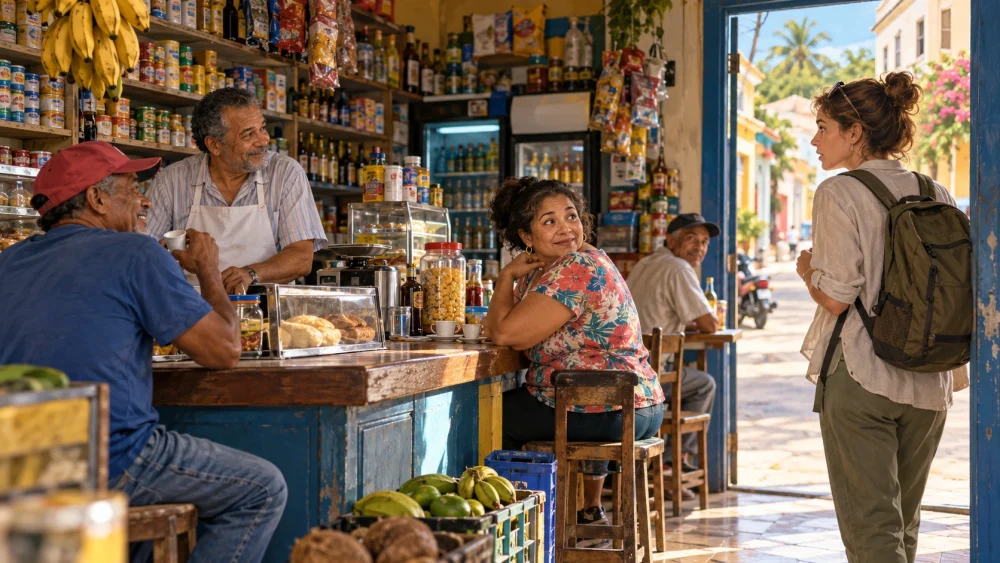
Try that in a Dominican colmado. Walk in, ignore the people already there, ask for what you want, pay, and leave. The transaction may have taken only thirty seconds. You may even have said “please” and “thank you.” But you skipped buenos días, and people noticed.
The same applies in a small waiting room or a shared elevator. Greet the room. Nobody expects a speech or an account of your health. You are simply acknowledging that other human beings are present. It takes less time than explaining afterward why you seemed unfriendly.
Nor will the American shortcut serve you particularly well in Europe. Walk into a small shop in France and launch straight into your question without saying bonjour. The shopkeeper may answer you, perhaps in excellent English. But you have already made an impression. You approached a person as though they were a search box.
There is a fair criticism of the American “How are you?” when the person asking has no intention of hearing the answer. It can sound absurdly mechanical. But dropping every greeting because one phrase has become hollow is a strange solution. A sincere “Good morning” does its job perfectly well.
A greeting also does more than start a transaction. It gives two strangers a harmless way to recognize each other. Remove those little exchanges from shops, elevators, and waiting rooms, and daily life becomes a series of people getting past one another. That may be efficient. It can also be lonely.
It changes the tone of a conversation before the subject has even been raised. A question preceded by buenos días sounds different from a demand fired across a counter. A simple, familiar opening tells both people where they stand. Without it, each has to guess whether the other is impatient, unfriendly, or merely following some new rule of communication.
What fascinates me is the confidence with which such a rule can be taught in one country and treated as an upgrade for the rest of the world. In many places, people do not need training to remove greetings from daily life. They would regard that as training in how to be rude.
Food exposes the same blindness, usually with better results.
Suppose you are served a good piece of stewed chicken in the Dominican Republic. You carefully work at it with a knife and fork, leave meat around the bone, and place your utensils neatly on the plate. You think you have behaved beautifully. The person who cooked it may wonder whether you liked it at all.
Now imagine someone in New York attacking a slice of pizza with a knife and fork. They are entitled to do it, of course. But people will look up. A New Yorker knows what a slice is for: you pick it up, fold it if you like, and eat it while it is hot. The knife and fork look fussy because they get in the way of enjoying the thing.
Your performance with the chicken can look much the same. If it is good, pick it up. Get the meat off the bone. Lick your fingers if the occasion allows it. The cook is more likely to appreciate an empty bone than your display of cutlery skills.
Time presents a more expensive lesson. An invitation to dinner at seven does not always mean the host expects you on the doorstep at 7:00 sharp. At some Dominican gatherings, you may arrive to find the host still dressing and the ice still on its way. Your punctuality has made you an extra task.
That does not mean you should arrive late to a business meeting or a medical appointment. It means you have to learn the difference between an appointment and a social invitation. If you are unsure, ask. Standing in someone’s doorway with a lecture about respecting time will not make the evening start any sooner.
Then there is the sharp psst across a noisy patio to get someone’s attention. An American may hear it and bristle. Here it can be an ordinary, effective signal. Before deciding you have witnessed a collapse of manners, watch whether anyone involved appears offended.
Nicknames require even more attention. You may hear Gordo, Flaca, or Moreno used between people who know each other well. Translate the words into English without the relationship around them and you may be shocked. Sometimes a remark about appearance really is unwelcome. But sometimes what sounds blunt to an outsider is a familiar name spoken with affection. You cannot work that out from a dictionary alone, and you certainly should not start handing out such names yourself.
You do not have to love every custom. Keep your knife and fork if you want. Arrive on time when time matters. Tell someone if you dislike a nickname.
But visitors need to understand whose home they have entered. The speed of American life does not make American manners the standard against which everyone else must be judged. And a habit does not become progress simply because it has been repackaged as efficiency on social media.
You may already see that efficiency arriving in local shops and public spaces: someone walks in without a greeting, asks a question, gets an answer, and leaves without ever quite meeting the person who helped them. One exchange is no catastrophe. Repeat it often enough, though, and something ordinary and valuable disappears.
So say good morning. Watch how dinner is eaten. Listen before correcting anyone. These are small things, which is why they are so easy to dismiss and so easy to keep.
And the next time you ask, “Why on earth do they do it like that?”, be prepared for someone to ask you the same question.