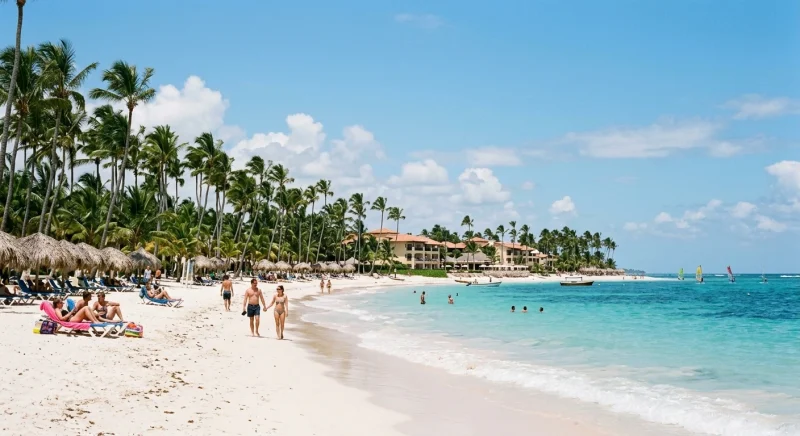
Punta Cana was never a town. It was a closed-loop financial apparatus built on cheap land, imported concrete, and total isolation. For thirty years, it worked because mass tourism is an industry that explicitly trades in predictable containment: fly the customer into a private airstrip, bus them straight to an Spanish-owned enclosure, feed them pre-calculated calories, and fly them out before they notice the country they’re standing on.
It was a logistics triumph. But closed-loop systems have a structural flaw: they require total environmental and operational stability to maintain the illusion. The moment real-world friction leaks through the perimeter, the margins collapse.
That friction arrived in two unmanageable forms: sargassum and indifference.
When millions of tons of rotting seaweed cover a beach, the resort model breaks down at its most basic unit. You can deploy floating barriers and hire crews to haul rotting algae off the sand at 5:00 AM, but you cannot hide a sulfur stink that fills a ocean-view suite. When guests pay four figures to sit inside a bubble, they expect the bubble to control the Atlantic Ocean. It can’t. The photos end up on social media, skipping the marketing department entirely.
The deeper problem isn’t the seaweed, though. It’s the commodity trap.
When you insulate a guest from the surrounding culture so thoroughly that their resort experience is identical to an enclave in Cancún or Jamaica, you turn your destination into a raw commodity. Once a trip to Bavaro is functionally interchangeable with a trip to Quintana Roo, the customer stops shopping for a destination and starts shopping for price.
To hold room rates down while preserving profit margins for European holding companies, the operator cuts cost on maintenance, service, and food quality. The physical infrastructure degrades. The repeat visitor—the only metric that actually signals destination health—quietly disappears. The headline numbers stay high because the Dominican government keeps tracking raw bodies entering the airport, but the yield per visitor shrinks. You’re moving more bodies through the halls to make less money.
The ultimate proof of decay isn’t in the public departure lounges; it’s in the private equity ledgers.
The original capital that engineered the corridor isn’t expanding Punta Cana anymore. They’re running it as a cash cow—an aging asset class to be milked for residual yield while deferring major capital expenditure. The real money has already shifted focus toward Miches and the Samaná Peninsula, looking to capture the next tier of higher-value travelers under the banner of “authenticity”—the very thing they spent thirty years paving over in the East.
Punta Cana won’t go bankrupt. The flights will keep landing, the buffets will keep cycling through processed food, and the resort gates will stay locked. But as an engine of real growth, it’s finished. The capital that built it has already written off its future, leaving behind a massive, highly efficient machine running strictly on inertia.