The story no one told you about baseball, soccer and the empires that decided your favourite sport
By Alec Corday | Kiskeya Life
On 19 July 2026, Spain defeated Argentina 1–0 in the 2026 World Cup final, played at the New Jersey stadium. Ferran Torres scored in the 106th minute, and Spain became world champions for the second time — the first was in 2010 — making history as the first federation to win the men’s and women’s World Cups consecutively.
The whole world is celebrating. Except three countries.
Cuba, Puerto Rico and the Dominican Republic — the only Spanish-speaking countries in the world where baseball beats soccer — are watching the World Cup from the outside, as always. And amid the global euphoria around soccer, it seems to me like the perfect time to ask a question I have wanted to answer for years: why aren’t we there?
The answer, as I discovered after months of researching this subject, has nothing to do with talent. Or the climate. Or geography. It has to do with something far more powerful: who arrived first, with what money, and with what agenda.
The map that makes no sense
Take a map of Latin America. Country by country, soccer appears. Brazil. Argentina. Mexico. Colombia. Venezuela. Costa Rica. Haiti. All of them. Absolutely all of them.
Except three.
Cuba, Puerto Rico and the Dominican Republic are the only Spanish-speaking countries in the world where baseball beats soccer. And the most intriguing question of all is not on the general map — it is on the island of Hispaniola.
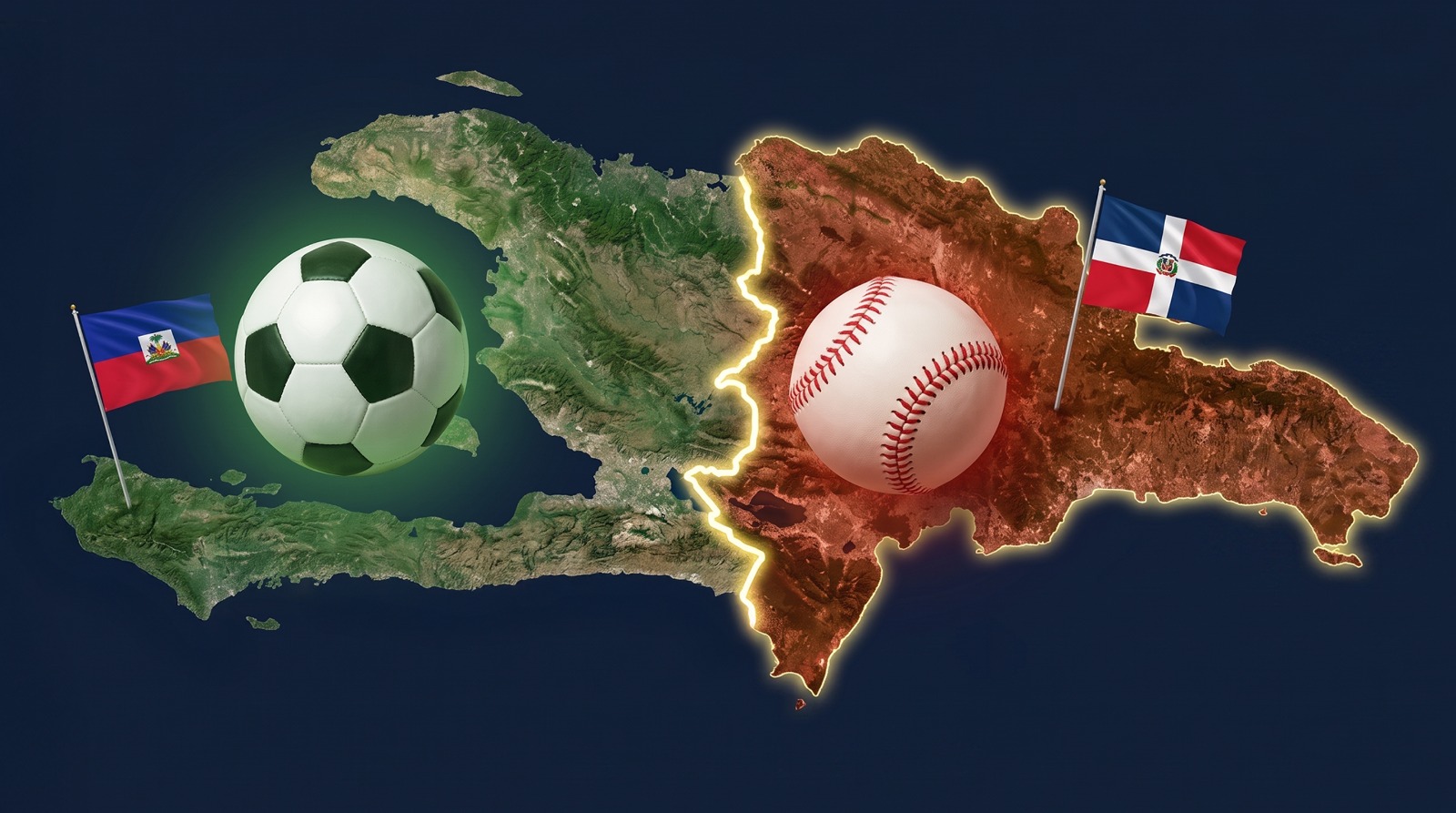
Haiti plays soccer passionately. The Dominican Republic plays baseball devotedly. Same climate. Same geography. The same island, literally divided by a border. And yet, two completely different sports on either side. Haiti even qualified for the 2026 World Cup — its second appearance in history, after 52 years of silence — while the Dominican Republic watched from the outside.
If sport depended on climate or terrain, both countries would have the same sport. Something else decided this. And that something was not accidental.
It did not come from the Americans. It came from Cuba.
Here is the first fact that surprises almost everyone: baseball did not arrive in the Dominican Republic with the American Marines in 1916. It arrived decades earlier, in the hands of Cuban refugees.
Cuba was at war with Spain. The Ten Years’ War (1868–1878) displaced thousands of Cuban families who fled to Puerto Rico and the Dominican Republic, settling mainly in the Dominican east’s sugar ports: San Pedro de Macorís and La Romana. And they brought their baseball with them.
But there is something even more fascinating: in Cuba, baseball was not just a sport. It was a political statement. Playing baseball in colonial Cuba was a way of telling Spain: we are looking elsewhere. We are the future. Spain understood this perfectly, and on several occasions banned baseball precisely for that reason.
A sport born as an act of anti-colonial rebellion reached the Spanish-speaking Caribbean long before any Marine set foot on these shores. And when the Americans arrived in 1916, they found Dominicans already playing baseball — and playing it well.
The Marines, the sugar estates and the MLB machine
When the American Marines arrived in 1916, baseball was already here. But what the Americans did was cement it in three ways that made it practically impossible to displace.
First, the sugar estates. American sugar companies organised teams and leagues during the downtime between harvests, giving baseball infrastructure and sponsorship throughout the eastern part of the country. They even paid cricket players — the cocolos, immigrants from the British islands who worked on the estates — to switch to baseball.
Second, the Trujillo era. In 1937, the dictator imported stars from the American Negro Leagues — Satchel Paige, Josh Gibson and Cool Papa Bell — for his personal team, the Ciudad Trujillo Dragons. Baseball was sealed as a sport of national prestige.
Third, and perhaps most decisively: Major League Baseball academies. In 1987, the Los Angeles Dodgers opened Campo Las Palmas, the first MLB academy on Dominican soil. By 2003, all 30 Major League teams had active academies in the Dominican Republic. Baseball became the only real path to economic escape for thousands of Dominican young people. Today, the Dominican Republic has more than 100 active Major League players — more than any other foreign country — and has produced more than 700 players since 1950.
So why does Haiti play soccer?
The answer to the Haitian question is almost identical to the Dominican answer, only with a different empire.
Haiti was a French colony. And although it became independent in 1804 — becoming the world’s first Black republic, in one of the most extraordinary revolutions in history — the Haitian elite never stopped looking towards Paris. French was the language of education and culture. To be cultured in Haiti meant being a little French.
At the beginning of the 20th century, when soccer became fashionable in France, Haiti’s elite adopted it for the same reason as always: it was what important people did. By 1904, the Haitian Football Federation already existed. By 1912, there were regional championships in Port-au-Prince.
When the American Marines arrived in Haiti in 1915 — one year before they arrived in the Dominican Republic — soccer had already been rooted in Haitian society for more than a decade. They could not displace it. It was already too much their own.
The result: in 1974, Haiti qualified for its first World Cup in Germany, where Emmanuel Sanon scored a goal that ended Italian goalkeeper Dino Zoff’s legendary unbeaten run. In 2026, Haiti returned to the World Cup for the second time in its history, facing Brazil, Morocco and Scotland. They lost all three matches, but they were there — in the same tournament where Spain has just been crowned champions. A country that has survived earthquakes, dictatorships and decades of poverty sent its national team to the World Cup. Because soccer in Haiti is not just a sport. It is identity.
The pattern repeated throughout Latin America
The Dominican story is not unique. It is part of a pattern repeated across the continent.
Nicaragua: baseball arrived with the Marines who occupied the country between 1912 and 1933. Panama: it arrived with the American engineers who built the Canal from 1903 onwards — Rod Carew and Mariano Rivera came from there. Colombia’s Caribbean coast: it arrived with the North American fruit companies that dominated the Caribbean coast. Venezuela: it arrived with the American oil companies that reached Lake Maracaibo in the 1920s — Miguel Cabrera and Johan Santana came from there.
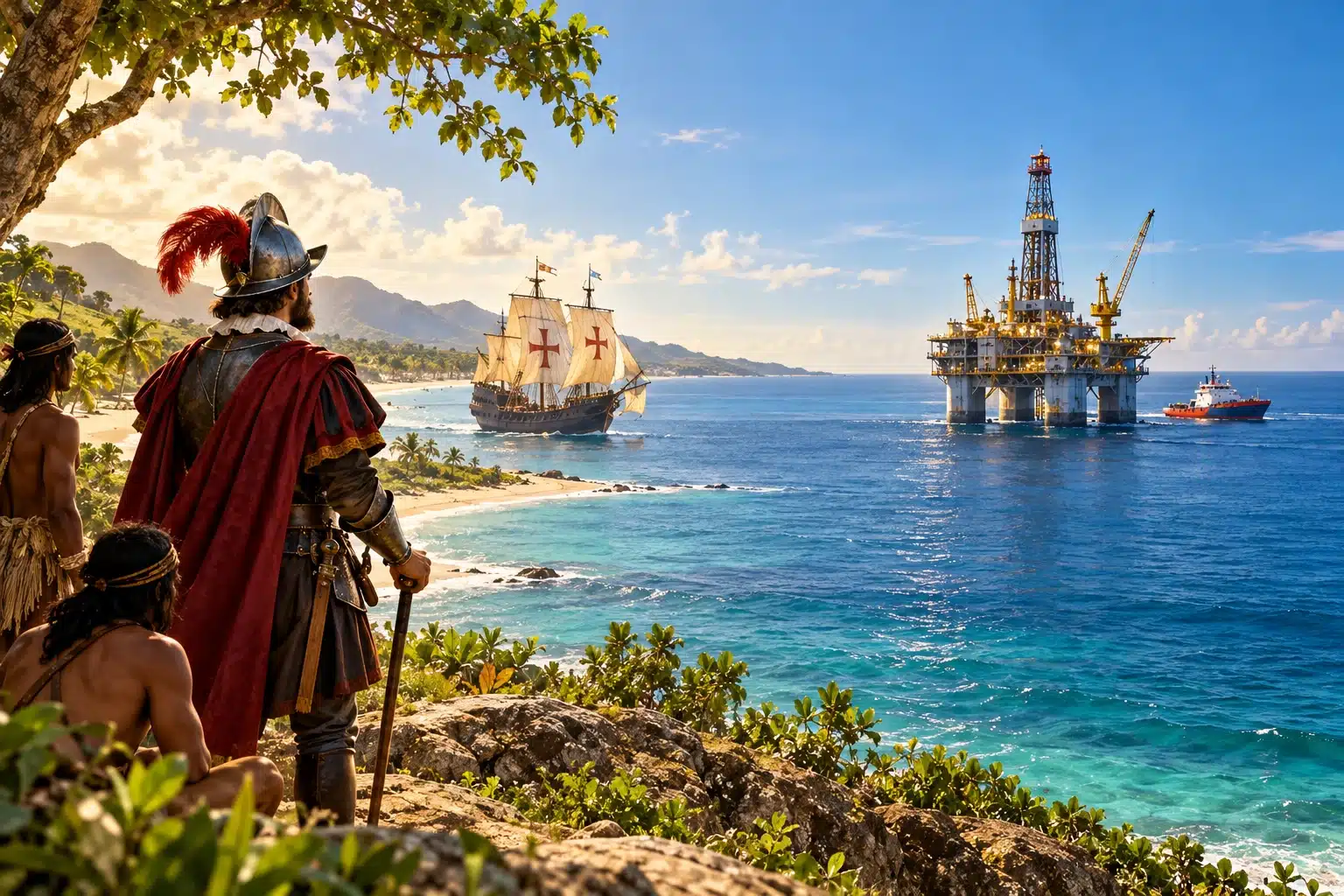
The pattern is always the same: where American economic or military influence arrived, baseball arrived. Where British influence arrived through trade and railways — Argentina, Uruguay, Brazil and Chile — soccer arrived. The sport you play is not a coincidence. It is political geography.
And Dominican soccer? It exists. And it is growing.
Soccer has existed in the Dominican Republic since the 1940s, when exiles from the Spanish Civil War arrived and organised the first clubs: El Pindú in Santo Domingo and El Cóndor in La Vega. But it took decades to become institutionalised. The Dominican Football Federation was founded in 1953, and the first professional Dominican Soccer League did not exist until 2015.
There is one place in the Dominican Republic where soccer was always more popular than baseball: Jarabacoa. And the reason is not the cool mountain climate, as many people assume. It is because Salesian missionaries arrived there in 1947 and used soccer as a youth-development tool. The same mechanism as always. A different institution.
In 2025, the Dominican men’s national team played in its first CONCACAF Gold Cup, facing Mexico before 54,000 spectators at Los Angeles’ SoFi Stadium — and scoring two goals against the tournament’s eventual champions. In October 2024, the Dominican Republic hosted the FIFA Under-17 Women’s World Cup, and the women’s national team earned the country’s first point and scored its first goal in a FIFA World Cup.
Dominican soccer is growing. It is being driven by a generation of players raised in Spain and the United States — Junior Firpo, Mariano Díaz and Pablo Rosario — and by exposure to European soccer through social media and the World Cup. Today, it is the algorithm that decides which sports become popular. Before, it was the empires. The mechanism is the same. Only the tools have changed.
The uncomfortable conclusion
As Spain celebrates its second world title and the whole world vibrates with soccer, it is worth asking ourselves an honest question: why can’t we experience that moment?
If you like baseball — if you carry it in your blood, if you cry when Licey wins, if your Sunday is organised around a game — that is completely yours. It is genuine. It is real.
But it is worth knowing that this love did not arise from nothing. It was planted by economic and political decisions made 150 years ago by people who probably never thought about you. You inherited it from your family, who inherited it from their neighbourhood, which inherited it from the sugar estates, which inherited it from the Cubans, who turned it into rebellion against Spain.
Knowing that history does not diminish the value of what you feel. On the contrary: it shows you that what seems natural and inevitable today is actually the result of a chain of human, political and economic decisions. And if a chain of decisions brought us here, then the future can also be different.
That is exactly what is happening today. And perhaps, in a few years, we will see the Dominican Republic at a soccer World Cup. Not because someone orders it. But because a generation decided — freely, this time — that it wanted to be there.
— — —
For the complete story — including the incredible story of Pelé in Santo Domingo, the sinking of the USS Memphis and the role of the Salesians in Jarabacoa — watch the full video on the Kiskeya Life channel. And tell us in the comments: did you choose your sport? Or did you simply grow up with it?